


The leather trench coat in the Soviet Union was never merely a garment; it was a notification of intent. In the image provided, the figure in the center frame dominating the visual hierarchy is not wearing military drab, but the sleek, dark armor of the secret police aesthetic—a visual lineage tracing back to the Cheka and the NKVD. This man stands amidst a sea of ushankas and wool greatcoats, a sharp contrast that signals authority operating outside the standard chain of command.
The crowd surrounding him—a mix of uniformed conscripts and civilians—looks not at the camera, but past it, or inward, wearing the collective expression of a populace that knows it is being watched even when it is not being seen.
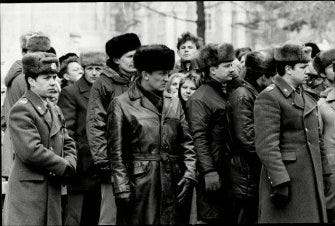
This photograph captures the physical manifestation of the Soviet security state just before its hardware collapsed and its software migrated online. The men in this frame are the analog predecessors to the digital bots and trolls that now patrol the information ecosystem. The leather-clad operator represents the ‘Active Measures’ (Aktive Maßnahmen) officer: embedded, distinct, yet blending into the chaotic background of the general population. The goal is not to convince you of a lie, but to exhaust your ability to believe the truth.
The most effective censorship is not the suppression of information, but the flooding of the channel with noise until the signal becomes indistinguishable from the static.
We look at this image and see a history that we believe ended in 1991. This is a fatal error in Western perception. The physical empire dissolved, but the psychological doctrine of *dezinformatsiya* did not require borders or walls; it only required a transmission vector. In the 1980s, that vector was the planted newspaper story or the whispered rumor in a breadline. Today, it is the meme you just shared. We are living in a zombie Cold War, where the combatants are dead but their strategies are running on automated loops.
Reflexive Control: The Architecture of Your Rage
The Soviet concept of ‘Reflexive Control’ is the hidden engine behind the chaos of the modern internet. It is the practice of conveying specially prepared information to an opponent to incline him to voluntarily make the predetermined decision desired by the initiator. Look closely at the faces in the crowd: there is a tense passivity, a waiting for instruction, a paralyzing uncertainty. This is the desired state of the victim of Active Measures. If you cannot convince a population to love the Party, you must ensure they trust no one else. You atomize the society.
