


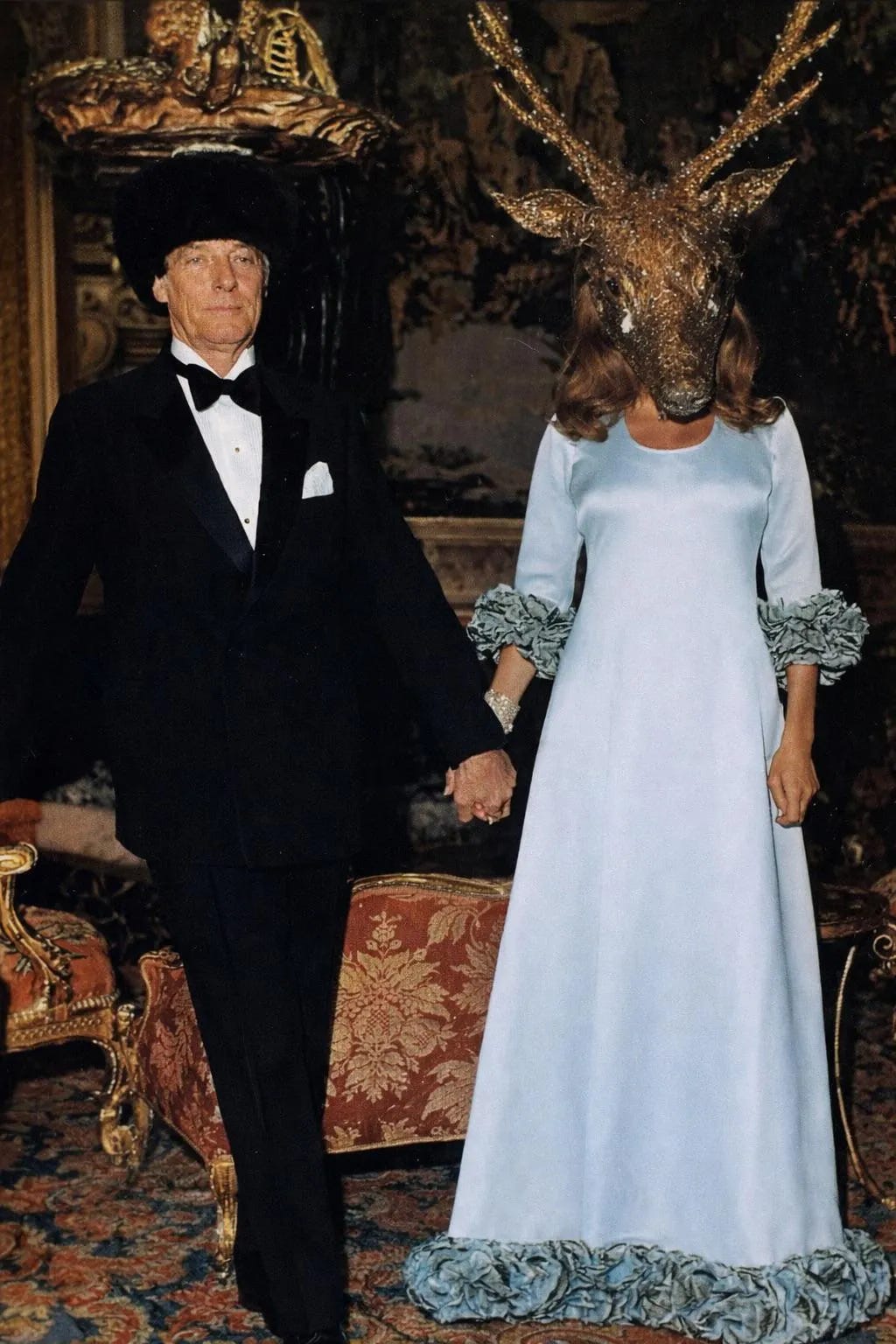
The year is 1972. While the geopolitical tectonic plates are grinding—Vietnam is effectively a charnel house, the Watergate break-in has just primed the fuse for Nixon’s immolation, and the Bloody Sunday massacre has stained the streets of Derry—Guy and Marie-Hélène de Rothschild are holding hands in the crushing opulence of the Château de Ferrières.
Look at them. This is not merely a costume party; it is a declaration of immunity. The man, Guy de Rothschild, a titan of European banking, wears a tuxedo and a somewhat ambiguous headdress—a nod to a surrealist still-life, perhaps, or merely a textural disruption of the formalwear. But the woman, Marie-Hélène, the doyenne of Parisian high society, has shed her humanity entirely. She wears the head of a stag, its eyes weeping tears made of real diamonds.
This image is the visual definition of “investigative noir” brought to life. It is the smoking gun of a class war that the rest of the world didn’t realize was being fought on a spiritual plane. The atmosphere is thick, not just with wealth, but with a heavy, suffocating silence. You are looking at the apex of the social pyramid, where the air is too thin for morality to survive. The mask reveals more than the face ever could; here, the mask screams that reality is merely a suggestion for those who can afford to rewrite it.
They stand in the Grand Hall, a space designed to dwarf the individual, surrounded by the ghosts of history and the glittering elite of the 20th century. Salvador Dalí is somewhere in the room. Audrey Hepburn is nearby, her head caged in bird wire. But in this frame, the focus is absolute. It is the juxtaposition of the mundane tuxedo and the mythological beast. It is a snapshot from the “Diner de Têtes Surréaliste,” a night that has since fueled a million conspiracy theories, not because of what actually happened, but because the imagery strikes a chord of primal fear in the common observer. It looks like a ritual because, in the sociological sense, it is one. It is the ritual of exclusion.
01 // The Surface Observation
At first glance, the photograph appears to be a whimsical artifact of the jet-set era—a high-budget version of a Halloween masquerade. The lighting is harsh, direct, likely a flashbulb cutting through the dim ambience of the château, giving the scene a flattened, stark quality common to 1970s society photography. The colors are muted but rich: the deep black of the tuxedo, the icy, spectral blue of Marie-Hélène’s gown, and the jarring organic gold and brown of the stag mask.
However, a forensic visual analysis reveals the unsettling architecture of the image. Look at the posture. Guy de Rothschild stands with the casual, bored confidence of a man who owns the building, the land, and arguably the debt of half the guests. He is holding Marie-Hélène’s hand, but there is no warmth in the grip; it is a presentation. He is presenting the Beast.
Marie-Hélène’s dress is deceptively simple, a column of pale blue fabric that ghosts over her frame, ending in ruffled cuffs and a hem that suggests waves or perhaps clouds. But the headpiece—the giant, taxidermy-style stag head—violates the rules of proportion and comfort. It is monstrosity made chic. The “tears” are the critical punctum of the image. They are diamonds.
“Surrealism is destructive, but it destroys only what it considers to be shackles limiting our vision.” — Salvador Dalí
Here, the destruction is inverted. Surrealism was founded to disrupt the bourgeoisie, to smash the rational chains of the ruling class. In this ballroom, the ruling class has cannibalized the revolution, wearing the symbols of their own disruption as jewelry. The appearance of reality here is that of a fever dream, but one carefully curated by the hostess. The staggering size of the mask renders her anonymous, yet hyper-visible. She is no longer a person; she is an archetype, a weeping forest god dragged into a palace to amuse the bankers.
02 // The Architect’s Intent
The design intention of the Rothschild Surrealist Ball was not merely entertainment; it was the engineering of a social singularity. Marie-Hélène de Rothschild, known for her relentless perfectionism and hunger for the unique, did not just send out invitations; she issued challenges. The invitations themselves were written backward, requiring a mirror to be deciphered—a clear signal that the guests were about to step through the looking glass into a world where standard logic was suspended.
Every element of the evening was designed to destabilize. The château, floodlit in amber to simulate a burning castle, set a tone of apocalyptic grandeur before the guests even exited their limousines. Inside, the staircase was lined with servants dressed as cats—not in cute, theatrical costumes, but in uncanny, prowling attire—who were instructed to pretend to be asleep or to purr menacingly at the arrivals. This is a crucial design choice: the dehumanization of the service staff. By turning the help into animals, the Rothschilds reinforced the god-like status of the guests.
The dinner tables were laden with surrealist grotesqueries: plates covered in fur, bread rolls dyed blue, and centerpieces featuring torn-apart dolls and dead turtles. This was the ‘Design of Excess.’ It was meant to be repulsive and exquisite simultaneously. The intention was to create an environment so insular, so detached from the struggles of the common man, that it functioned as a separate dimension.
In 1972, while the world burned with napalm and civil unrest, the Rothschilds were curating a dreamscape of diamond-studded tears. The psychological architecture was designed to bond the elite together through shared absurdity. If you were in the room, wearing a birdcage or a gramophone on your head, you were part of the conspiracy of wealth. You were safe. The outside world could not touch you here.
03 // The Shadow Records
Beyond the frame of this photograph lies a web of logistical and moral realities that transform this from a party into a case study of power. The guest list was a weapon. To be invited was to be anointed; to be excluded was social death. Among the attendees were the Baron Alexis de Redé (wearing a mask with four faces), Audrey Hepburn, Marisa Berenson, and members of the European royal families. But let us look at the labor required to sustain this fantasy.
Hundreds of seamstresses, chefs, lighting technicians, and security personnel labored to create this seamless illusion. In the background, invisible in the flashbulb’s glare, are the mechanics of the event. The “cats” lining the stairs were real people, likely paid a pittance compared to the cost of a single diamond on Marie-Hélène’s mask, forced to prostrate themselves and act as beasts of burden for the amusement of the aristocracy.
Furthermore, the timing is critical. 1972 was a pivot point in global economics. The Bretton Woods system had effectively collapsed; the gold standard was being dismantled. The very people dancing in this room were the architects of the new fiat currency world order. While they dined on “accidental” food and wore masks of madness, they were arguably celebrating the consolidation of financial power that would define the neoliberal era of the 1980s.
“The secret of the demagogue is to make himself as stupid as his audience so that they believe they are as clever as he.” — Karl Kraus
There is also the whisper of the occult. While secular historians dismiss the conspiracy theories surrounding this ball, one must acknowledge the *aesthetic* proximity to ritual magic. The stag is a pagan symbol of the Horned God; the inversion of writing is a trope of black magic; the labyrinthine nature of the château echoes Masonic initiations. The aesthetic proximity to ritual magic is accidental to the participants but essential to the mythos of the ruling class. They may not be summoning demons, but they are certainly summoning an aura of untouchable mystery that functions effectively the same way. The hidden reality is that they *want* you to wonder. They want the peasantry to speculate about what happens behind the closed doors of Ferrières, because fear and awe are the currencies of control.
04 // The Systemic Apparatus
This image is a microcosm of the broader system of dynastic wealth and the “Society of the Spectacle.” The Château de Ferrières itself is a character in this narrative. Built by Joseph Paxton for Baron James de Rothschild in the 19th century, it was designed to be the ultimate display of new money eclipsing old royalty. By 1972, the Rothschilds were the Old Money. The ball represents the terminal phase of aristocratic decadence—the point where power becomes so secure it must invent bizarre challenges to feel alive.
This event connects directly to the concept of “The Social Season” as a mechanism of political retention. In the 19th and early 20th centuries, balls were marriage markets and treaty negotiations. By the 1970s, they had evolved into performance art for the ego. The broader system at play here is the insulation of the ultra-wealthy. This class operates in a trans-national capacity; they are not citizens of France or America, but citizens of Capital.
The surrealist theme is particularly damning when viewed through the lens of systemic critique. Surrealism was an art movement born from the trauma of World War I, intended to unlock the unconscious and rebel against rationalist control. For the banking elite to co-opt this aesthetic is the ultimate act of neutralization. They aren’t hiding their power behind masks; they are displaying the monstrous nature of absolute freedom. They are showing us that they can purchase our rebellions, wear our nightmares as couture, and laugh about it over vintage champagne. The system absorbs all dissent and sells it back as luxury.
05 // Contemporary Echoes
The echo of the 1972 Surrealist Ball is deafening in the 21st century. We see its DNA in every Met Gala, in the performative excess of influencers, and most notably, in the dark corners of internet folklore. These images have found a second life online, often cited as “proof” of Illuminati rituals or Satanic cabals running the world. While factually dubious, these reactions speak to a genuine modern anxiety: the feeling that the elites are a different species, operating by arcane rules.
Culturally, this specific party was the direct visual inspiration for Stanley Kubrick’s *Eyes Wide Shut*. Kubrick, a meticulous researcher, studied the photos of the Rothschild ball to craft the atmosphere of the Somerton orgy. The masks, the silence, the underlying threat of violence beneath the veneer of civility—it all flows from this night in 1972.
Today, as wealth inequality reaches levels not seen since the Gilded Age, the image of Marie-Hélène as the Weeping Stag hits a nerve. It represents the “let them eat cake” of the late 20th century. We stare at these photos not to see the past, but to catch a glimpse of the secret machinery we suspect runs the present. We are looking for clues in the diamonds, trying to understand the mindset of a class that can watch the world weep and see only an opportunity for aesthetic expression.
In the end, the party ended. The Château de Ferrières was eventually donated to the University of Paris, effectively shedding the burden of its maintenance from the family ledger. Marie-Hélène died in 1996; Guy in 2007. The masks were taken off and likely stored in climate-controlled archives or auctioned to collectors.
But the image remains. The Weeping Stag stands as a permanent sentinel at the gates of history, a reminder of a night when the gods played dress-up. It leaves us with a lingering, uncomfortable question: When the music stopped and the masks came off, did they return to the real world, or is the world we live in merely the extended hangover of their party? The stag cries diamonds, but the viewer is left with the realization that in the game of history, we are neither the guest nor the host; we are merely the silence in the room.