


An investigative critique of static border fortifications, arguing that walls—from the Roman Limes Germanicus to the modern Rio Grande—serve as psychological placebos rather than effective military assets. The essay contends that hardening the periphery signals the atrophy of an empire’s ability to project power, ultimately locking the defenders in a prison of their own making.
Iron oxide is the color of empire in decline. Whether it is the rusted iron clamps of the Colosseum or the oxidizing bollards slicing through the Sonoran Desert, the hue remains the same. The image above captures not a moment of strength, but a tableau of strategic exhaustion: elite infantry, trained for rapid maneuver and violence of action, reduced to the role of manual laborers unspooling wire against a static horizon. A wall is not a military asset; it is a political sedative administered to a citizenry terrified of a fluid world.
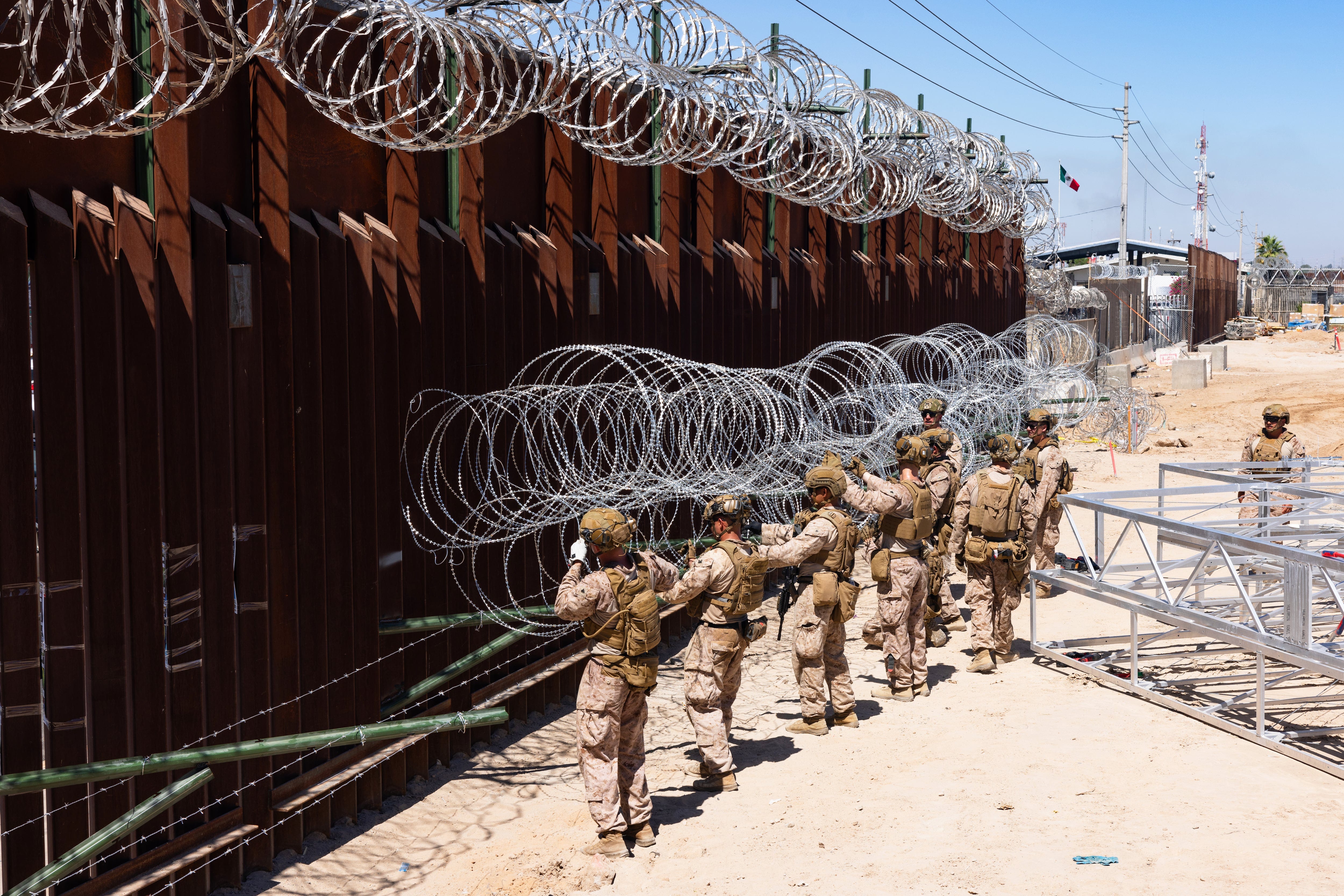
When a state commits to the wall, it commits to the defensive crouch. It is a tacit admission that the nation no longer possesses the vitality to influence the ‘barbarian’ lands through trade, diplomacy, or expeditionary deterrence. Instead, it chooses calcification. The distinct vertical slats of the modern border wall are functionally identical to the wooden palisades of the Roman *Limes Germanicus*. They represent a binary worldview—civilization here, chaos there—that history has repeatedly proven false. To draw a line in the sand is to announce the exact limit of your influence, turning a frontier of opportunity into a perimeter of fear.
The moment an empire builds a wall, it ceases to be an empire and becomes a fortress. Fortresses are not conquered; they are besieged. They are starved. And eventually, the gates are opened from the inside.
The Limes Germanicus: A Case Study in False Security
In the second century AD, the Roman Empire solidified its northern frontier. The *Limes Germanicus* stretched hundreds of miles, a complex system of ditches, watchtowers, and palisades designed to regulate the movement of Germanic tribes. Initially, it worked. It controlled trade and filtered migration. But structurally, it created a fatal dependency. The existence of the barrier convinced the Roman Senate that the threat was contained, allowing the internal muscle of the legions to atrophy.
Rome stopped looking outward. The Rhine and Danube legions, once the tip of the spear, settled down. They married local women, farmed the land, and became static garrison troops rather than mobile combat units. The wall did not keep the Alamanni or the Franks out; it merely blinded Rome to the shifting demographics and rising power bases occurring just beyond the tree line. When the Great Migration Period began, the *Limes* was not overrun in a single dramatic battle; it was simply bypassed, infiltrated, and rendered irrelevant by a tide that flowed like water around a stone.
Static fortifications are gravestones for empires that have forgotten how to maneuver. By fixing their attention on a physical line, Roman strategists ignored the asymmetric threats developing deep within Germania. The wall provided a psychological comfort that delayed necessary reforms in military doctrine. It allowed the Romans to believe the lie of permanence.
The Atrophy of the Vanguard
Observe the posture of the Marines in the image. These are not sentinels scanning for threats; they are construction workers clad in Kevlar. This is the degradation of the warrior caste into the constabulary. When high-end military assets are deployed to maintain static infrastructure, the opportunity cost is incalculable. When the vanguard becomes the border guard, the empire has already conceded the initiative to the adversary.
This deployment reflects a profound misunderstanding of defense in depth. A true defense is elastic; it absorbs, encircles, and destroys. A wall is brittle. It demands a linear distribution of forces, spreading manpower so thin that a breakthrough at any single point collapses the integrity of the entire system. This is the lesson of the Maginot Line: the enemy will not oblige your desire for a head-on collision against your strongest point. They will find the gap, the tunnel, or the corrupted gate guard.
We build walls to preserve our reality, but the very act of building them alters that reality. We lock ourselves in with our own stagnation, while the world outside evolves, adapts, and sharpens its claws against our stone.
The Psychological Prison of the Interior
The greatest danger of the wall is not that it fails to stop the enemy, but that it succeeds in deceiving the defender. The presence of the barrier creates a ‘security theater’ that pacifies the domestic population while doing nothing to address the root causes of migration or invasion. It shifts the focus from grand strategy—economic integration, foreign intelligence, forward engagement—to masonry and metallurgy.
Historically, the nations that wall themselves off suffer from a peculiar form of cultural suffocation. The Qing Dynasty’s Great Wall did not stop the Manchus, but the isolationism it symbolized certainly retarded China’s modernization relative to the West. Similarly, the Iron Curtain did less to keep NATO out than it did to trap the Soviet bloc in an economic pressure cooker that eventually exploded. Walls do not preserve culture; they pickle it.
In the modern context, the obsession with the physical border obscures the reality that the 21st-century threat environment is entirely permeable. Cyber warfare, economic subversion, and ideological virality do not respect bollards. By focusing on the tangible perimeter, we ignore the spectral threats that are already inside the gates.
The ultimate irony of the border wall is that it acts as a mirror. We look at the steel slats and think we are seeing protection, but we are actually seeing a reflection of our own limits. We are seeing a society that has run out of ideas, run out of expansionist energy, and has decided that the only remaining move is to close the door and hope the storm passes. History suggests the storm does not pass; it builds until the roof caves in.