


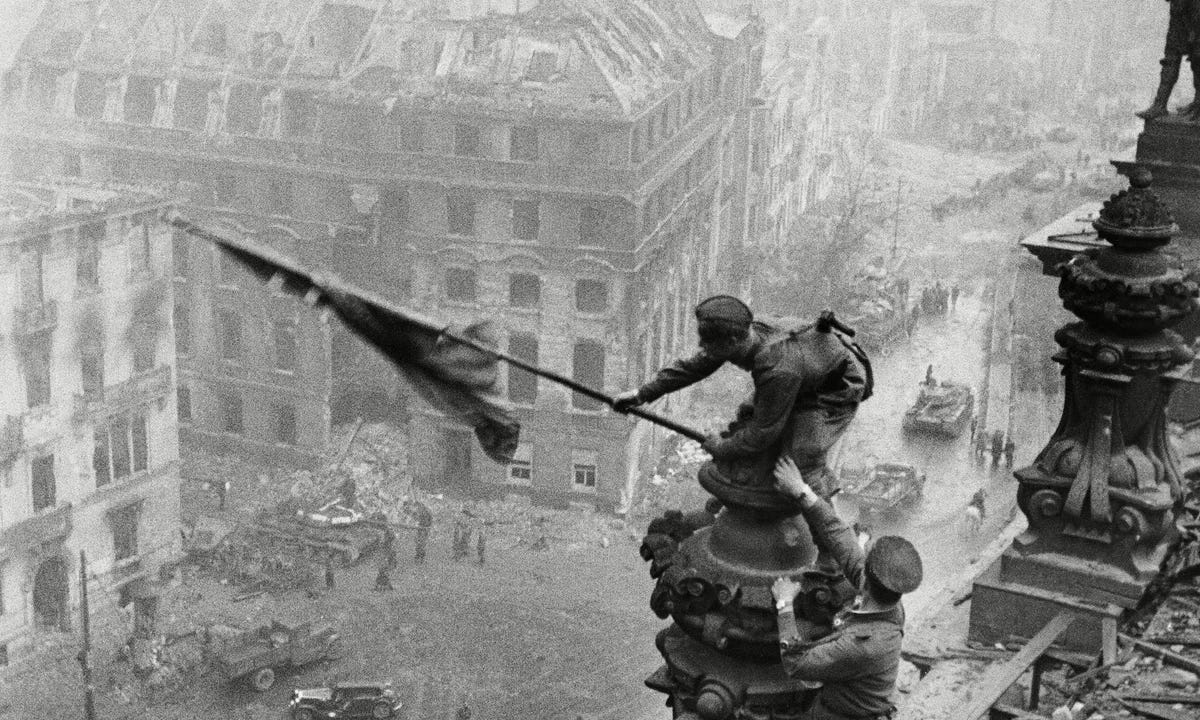
It is arguably the most recognizable silhouette of the twentieth century’s violent crescendo: a precarious, high-wire act performed above the burning skeleton of Berlin. A Soviet soldier, legs braced against the ornamental statuary of the German parliament, reaches out over the abyss to plant the Hammer and Sickle. Below him, the ruins of the Third Reich smolder in a hazy, industrial fog. To the casual observer, this is the definitive snapshot of the antifascist victory—a moment of raw, spontaneous triumph captured at the very second the heartbeat of Nazi Germany flatlined. It feels visceral, dangerous, and final.
However, the intelligence analyst looks at this image and sees not a moment, but a construction. The sensory overload of the photograph—the dramatic smoke, the perilous angle, the heroic posture—masks a quiet, bureaucratic intervention that occurred in a darkroom days later. This is not merely a photograph of war; it is a weaponized artifact of memory. The tension here is not just between the soldier and gravity, but between history as it happened and history as the State wished it to be remembered. We are conditioned to view photography as a mirror of reality, but in the hands of the Soviet state apparatus, the camera was a chisel, sculpting a narrative that required the removal of inconvenient human flaws. The image before you is a lie that tells a truth, but to understand the lie, one must look away from the flag and focus on the wrists of the man supporting the hero. There, in the grain of the original negative, lies the secret that Moscow tried to scratch out of existence.
I. The Appearance of Reality
At a superficial level, the image presents a classic tableau of conquest. We see two figures: the flag bearer, usually identified as Meliton Kantaria (though historically debated), and his support, Abdulkhakim Ismailov. They are perched atop the Reichstag, the symbolic heart of German legislative power. The composition is strikingly diagonal, creating a sense of dynamic movement that draws the eye from the bottom left ruins up to the fluttering banner in the top right. The high contrast of the black-and-white film emphasizes the grim atmosphere; the city below is a grey necropolis, while the figures are dark, solid, and undeniable.
The aesthetic is Romantic in the art-historical sense—man dominating nature (or in this case, the man-made inferno). It appears to be a candid capture of the first moments of liberation, implying that the photographer, Yevgeny Khaldei, scrambled up the stairs alongside the vanguard infantry to snap this shutter at the precise moment of victory. The viewer assumes this is May 2, 1945, in real-time. We see the bravery required to stand on that ledge. We see the culmination of the Great Patriotic War. The image acts as a visual period at the end of a long, bloody sentence. It presents itself as the ultimate proof of dominance: the enemy’s capital is not just taken; it is surmounted. The aesthetic power lies in its framing—the soldiers are literally above the destruction, suggesting a moral superiority as much as a physical one. It is an image designed to be printed on stamps, carved into statues, and etched into the collective consciousness as the singular representation of the Fall of Berlin.
II. Design & Orchestration
The architecture of this image was not serendipitous; it was engineered with the precision of a military operation. Yevgeny Khaldei, the TASS photographer, did not stumble upon this scene. By the time this photo was taken on May 2, 1945, the Reichstag had already fallen, and several other flags had been raised (and subsequently shot down or lost) during the night battles. Khaldei, acutely aware of the propagandistic value of the American flag-raising at Iwo Jima earlier that year, was under orders to produce a Soviet equivalent. The ‘spontaneity’ was entirely manufactured.
Khaldei brought the flag with him from Moscow—it was not a standard-issue military banner but a makeshift prop sewn together by his uncle from three red tablecloths appropriated from a government office. Upon arriving at the Reichstag, he recruited the soldiers to stage the re-enactment. He directed them like actors on a set, positioning them for the most dramatic angle against the backdrop of the Tiergarten. The intention was to create an icon that would transcend the messy, confused reality of urban combat. The Soviet leadership understood that the legitimacy of their post-war hegemony relied on controlling the visual narrative. This image was designed to be the cover art for the next century of Soviet history. It was intended to project order, unity, and absolute finality. The specific choice of the Reichstag (despite it having little strategic value compared to the Chancellery) was symbolic; it represented the heart of the German state, and planting the flag there was a visual metaphor for driving a stake through the vampire’s heart. Every element, from the angle to the flag itself, was a curated decision to maximize emotional impact and minimize ambiguity.
III. The Missing Actors
The true depth of this investigation lies in what was removed. In the original, unretouched photograph, the supporting soldier, Abdulkhakim Ismailov, is wearing two watches—one on his left wrist and one on his right. This seemingly minor detail was a catastrophic breach of the Soviet narrative. In the chaotic, vengeful atmosphere of 1945 Berlin, the Red Army was engaging in widespread looting. ‘Davai chasi’ (’Give me the watch’) had become a terrified refrain among Berliners encountering Soviet troops. A soldier wearing two watches was visual evidence of looting, a crack in the façade of the disciplined ‘Liberator.’
When the photo was developed in Moscow, the editors at TASS immediately recognized the danger. The image of the hero could not also be the image of the thief. Khaldei (or the editors) took a needle to the negative and physically scraped away the watch on Ismailov’s right wrist, blending it into the sleeve of his tunic. This act of deletion is the ‘hidden reality’ that defines the image’s legacy. It reveals the insecurity of the victor.
Furthermore, the dramatic, billowing smoke in the background was largely superimposed in the darkroom to add gravitas and obscure the less photogenic details of the ruined city. The reality outside the frame was one of exhaustion, rape, plunder, and the confused mingling of victorious troops and terrified civilians. The soldiers were not polished statues of Marxism-Leninism; they were tired men, likely intoxicated on victory and looted alcohol, engaging in the spoils of war. The ‘two watches’ represent the human cost and moral ambiguity of the conflict—the desire for compensation after four years of hell. By erasing the second watch, the State erased the humanity of the soldier, turning him into a two-dimensional archetype. The hidden reality is that the perfect victory was maintained only by physically altering the evidence of the crime.
IV. The Broader Systemic Pressure
This photograph is a microcosm of the entire Soviet information ecosystem, a system predicated on the concept of ‘Socialist Realism’—the demand that art and media depict reality not as it is, but as it *should* be in its revolutionary development. The manipulation of the Reichstag photo was not an anomaly; it was standard operating procedure. The broader system viewed historical truth as malleable clay, to be shaped by the needs of the Party.
This links directly to the systemic erasure of ‘unpersons’ (like Trotsky or Yezhov) from official photographs. The scratching of the watch is the same mechanism as the airbrushing of a politburo member, just on a smaller scale. Economically, this system relied on the total mobilization of culture. Photographers like Khaldei were not journalists in the Western sense; they were soldiers of the ideological front. Their output was a commodity of the state, valued only for its utility in maintaining social control and projecting power.
Moreover, the ‘two watches’ incident points to the broader economic reality of the Red Army soldier—often unpaid, underfed, and coming from a ravaged homeland, looting was an unofficial form of payment and vengeance tolerated by command until it became a PR liability. The system encouraged the brutality necessary to win the war but demanded the sanitization of that brutality to win the peace. The photograph sits at the intersection of these conflicting systemic imperatives: the need for a violent conqueror on the ground and a noble liberator in the press.
V. Modern Relevance
The echoes of Khaldei’s needle are deafening in the digital age. We often speak of ‘deepfakes’ and AI manipulation as new threats, but the Reichstag photo proves that the fabrication of reality is as old as media itself. Today, the ‘second watch’ is scrubbed not with a needle, but with metadata alteration, crop tools, and generative fill. We live in an era where state actors and influencers alike curate ‘perfect’ narratives by editing out the anomalies that betray the truth.
The modern viewer must ask: What is the ‘second watch’ in the images we consume from Ukraine, Gaza, or domestic protests? Is it the timestamp that doesn’t match? The reflection in a window? The shadow that falls the wrong way? Khaldei’s manipulation warns us that the most iconic images—the ones that make us feel the most—are often the ones most likely to be staged. The legacy of this image is the necessity of cynical forensics. We cannot accept visual evidence as proof of truth; we must treat it as proof of *intent*. The image tells us what the creator *wanted* us to see, and the modern history enthusiast must be trained to look for the scratches on the negative.
Yevgeny Khaldei passed away in 1997, having finally admitted to the staging and manipulation of his masterpiece. Yet, does the knowledge of the lie diminish the power of the image? In a strange way, the manipulation makes the photograph more historically significant, not less. It captures the victory over Nazism, yes, but it also captures the nature of the regime that replaced it. It preserves the heroism of the soldier and the paranoia of the State in a single frame.
When we look at the Reichstag flag today, we should not just see a flag. We should see the scraped-out void on a wrist—a ghost of a watch that tells the time of a different reality. History is not what happened; history is what survives the editing room. The challenge for us is to remember that for every flag flying high in the smoke, there is usually a detail on the ground that someone desperate tried to hide.