


An investigative dissection of the American post-war economic boom, revealing how the celebrated ‘Golden Age’ was not a triumph of free markets, but a fragile construct of government intervention and social commodification that sowed the seeds of modern inequality.
The confetti on the streets of New York in May 1945 did not mark the end of struggle; it marked the beginning of a vast, silent commodification of American life. The jubilant faces captured in the V-E Day crowds were not merely celebrating the defeat of fascism; they were unknowingly stepping onto a new battlefield defined by Karl Polanyi’s “double movement.” These soldiers and civilians, flush with the adrenaline of victory, were about to be transformed from citizens into consumers, and from community members into “fictitious commodities” within a market machine that viewed their labor as a raw input rather than a human necessity. The narrative that followed—of a spontaneous, self-regulating economic boom—is a convenient myth that obscures the terrifying fragility of the era. The jubilation of 1945 masked a structural tension that would eventually tear the social fabric apart: the incompatibility of a ruthless market with the human need for protection. The prosperity that followed was not a natural phenomenon, but a state-engineered dam holding back the floodwaters of capitalism’s inherent destructiveness.
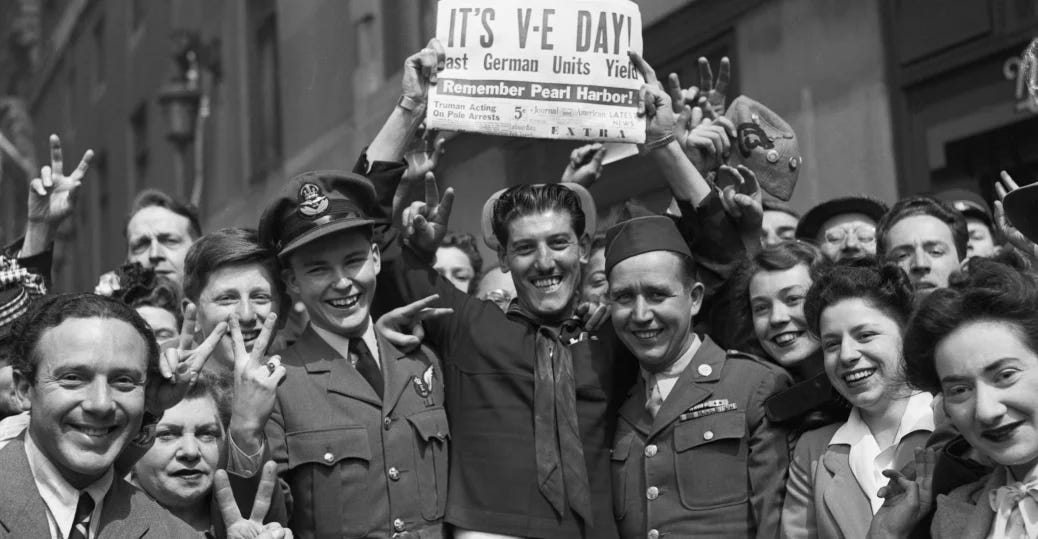
The drive for laissez-faire economic policies inevitably generates a counterforce that insists on the need for social regulation and protections against the market’s excesses.
The Myth of the Self-Regulating Machine
Conventional history remembers the post-war years as a testament to the American free enterprise system, a time when the invisible hand supposedly lifted the nation out of the Great Depression. This is a fabrication. The economic expansion, where real GDP nearly tripled, was not the result of government withdrawal, but rather the legacy of the New Deal and the massive industrial ramp-up of the war economy. The state
