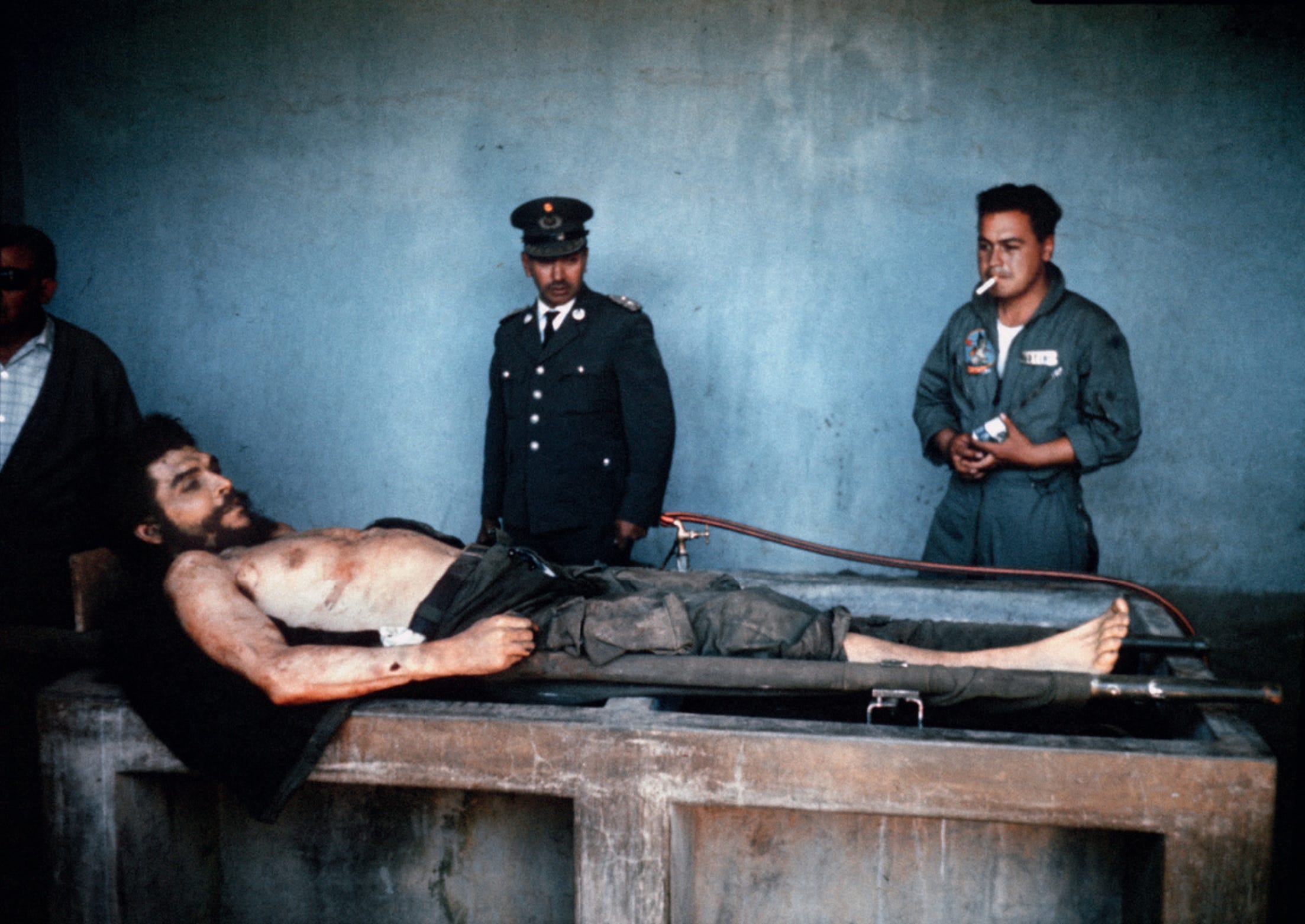
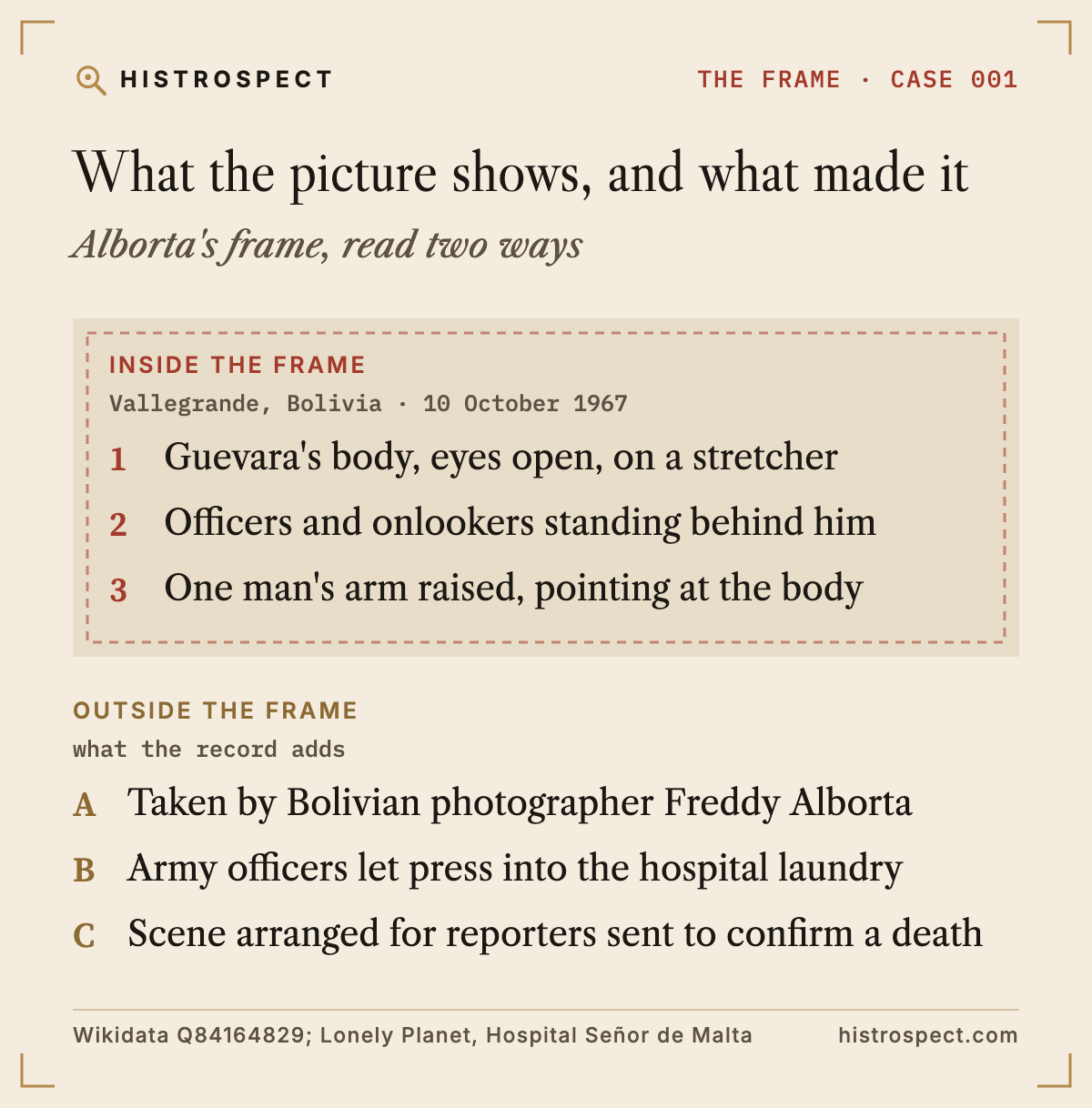
The eye goes to the face first. Che Guevara’s eyes are open, his head tipped back and a little to one side, a few days of beard on his jaw, his mouth not quite closed. He lies bare-chested on a stretcher set across a concrete sink. Only after a second or two does the eye climb past him, to the men standing over the body — Bolivian army officers and a handful of onlookers let into the room behind them, one with his arm raised, finger pointing down at the corpse as if he is making a point in a lecture.
This is the photograph Freddy Alborta made in the laundry of the Hospital Señor de Malta in Vallegrande, Bolivia, on 10 October 1967 [date unverified] — the image most people mean when they say they have seen Che Guevara dead. Guevara had been captured at La Higuera two days earlier and executed the day after that; Wednesday’s Case File follows that chain of orders. Here the subject is the room, not the road that led to it.
Set that image beside Alborta’s. In the one attributed to Villoldo, the body is alone: laid on the stretcher, head and shoulders propped against the sink’s edge, a water tap and coil of hose visible on the blue-washed wall behind him. No one else is in frame. It reads as a record — a thing photographed to be filed.
Alborta’s photograph is a different kind of picture, even though it was made in the same room, on the same body, within the same hours. The men are what make it a scene rather than a record.
Alborta shot from close to floor level, looking slightly up the length of the body toward the standing men — a low angle that does two things at once. It flattens the officers into a row along the top of the frame, and it gives Guevara’s chest and face the whole lower half of the picture, lit more evenly than anything behind him. The light is hard and local, the kind a single bulb or flash throws in a small tiled room, not daylight.
It was this combination — a body laid out and lit, a row of standing figures above it, heads tilted down — that led the critic John Berger, writing in Aperture in 1968, to compare the photograph with Andrea Mantegna’s Lamentation over the Dead Christ. Berger’s point was not that anyone in that laundry had a painting in mind. It was that the arrangement of bodies required to get a dead man and his witnesses into one frame has only ever had a small number of solutions, and this room had landed, probably without anyone intending it, on one of the oldest.
Nobody built that laundry to be a stage. It had a sink built for washing linen, a wall built to be hosed down, a bare bulb built to see by. Whoever decided to lay the body there — on a slab made for a different purpose, in a room nobody would mistake for a chapel — was choosing convenience, not symbolism: it was a flat, washable surface in a building with a working water supply, in a town that had not expected to need one. The photograph did the rest.
What the image cannot tell us, and what it was never built to answer, is the order in which the cameras arrived, who decided where the officers would stand, or whether the man with his arm raised was pointing for the room or for the lens. Alborta later gave his own account of being in that laundry; other photographers were present too, and their frames don’t all agree on who stood where. None of that is settled by looking.