


A forensic deconstruction of a rare 1930s photograph depicting Basil Zaharoff, the notorious ‘Merchant of Death,’ in the ceremonial robes of the Order of the Bath. This analysis challenges the narrative of the ‘dignified statesman’ to reveal the deep-seated corruption of an establishment that canonized a war criminal in exchange for geopolitical leverage.
History is often seduced by the costume of authority, and nowhere is this seduction more grotesque than in the image of Basil Zaharoff draped in the silk and feathers of the British aristocracy. To the uninitiated eye, this is a portrait of a distinguished elder statesman, perhaps a diplomat or a royal confidant, entering a vehicle after a solemn ceremony. The ostrich feathers fluttering from his bicorne hat and the heavy mantle of the Knight Grand Cross of the Order of the Bath suggest a life of chivalry, honor, and public service. This is the first and most dangerous assumption the image invites us to make: that the man inside the robes deserves them.
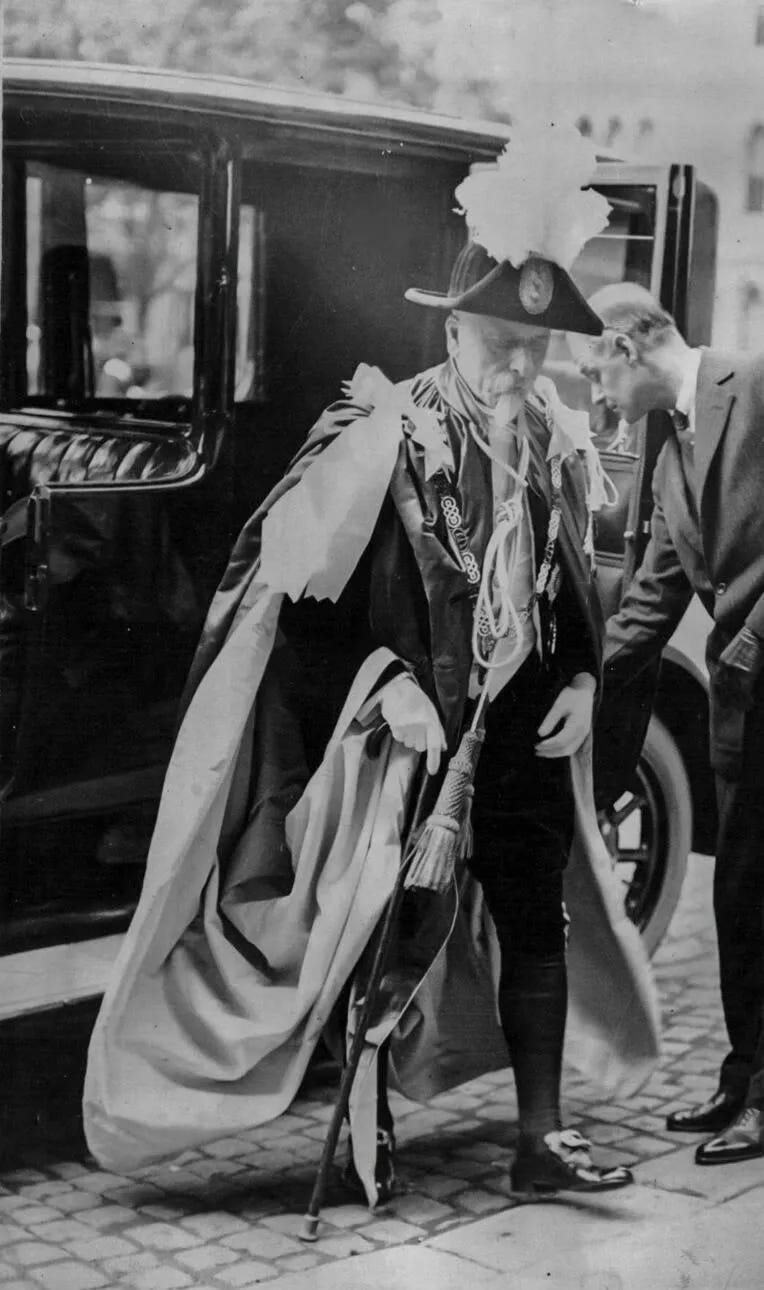
The reality requires us to strip away the sartorial pomp. The man beneath the feathers is the ‘Merchant of Death,’ a stateless arms dealer who perfected the art of playing nations against one another to sell the Maxim machine gun to both sides of a conflict. The irony of his attire is suffocating; the Order of the Bath, theoretically rooted in spiritual purification and knightly virtue, clings to a body that engineered the industrial slaughter of the First World War.
By the time this photograph was taken in the 1930s, Zaharoff had burned his diaries and successfully purchased his legitimacy. This image is not a documentation of honor; it is evidence of a transaction. It captures the moment the British establishment publicly kissed the ring of the monster it created, trading moral bankruptcy for access to his munitions empire. The feathers do not signify purity; they are a camouflage pattern for high society.
Calculated Frailty: The Weaponization of Age
A second, subtle layer of propaganda operates through the physiology of the subject himself. We see a stooped figure, heavily reliant on a cane, his gaze cast downward in what appears to be humility or exhaustion. The viewer instinctively pities the fragility of the elderly. This visual cues a narrative of harmlessness—how could this trembling old man be the shadowy inspiration for Ian Fleming’s Ernst Stavro Blofeld? How could he be the puppet master of European geopolitics? This assumption of frailty acts as a shield, deflecting the moral scrutiny due to a war criminal.
However, we must interrogate the timing. Zaharoff was obsessed with secrecy; he was known as the ‘Mystery Man of Europe’ precisely because he avoided the lens. That he appears here, in full regalia, in a public street, suggests a calculated performance of visibility. The cane is not merely a crutch; it is a prop in the theater of his retirement. By presenting himself as a decaying relic, he disarms his critics. He effectively argues that he is history, past tense, rather than an active agent of corruption. Yet, even in this era, his tentacles were deep in the financial sector and the Monte Carlo casino, extracting wealth from the post-war ruins he helped create. The downcast eyes are not looking at the cobblestones in contemplation; they are avoiding the judgment of the lens, maintaining the wall of silence he built around his soul.
The Invisible Architecture of Complicity
Investigative history demands we ask: Who is facilitating this scene? The composition includes a younger man, likely a valet or chauffeur, holding the door of the limousine. He is faceless, deferential, his body angled entirely to serve the central figure. This attendant represents the millions of nameless individuals—factory workers, soldiers, bureaucrats—who kept Zaharoff’s machine running. The interaction is seamless; the door opens, the merchant enters, the machine departs. There is no friction.
This lack of friction is the true horror of the image. The car itself, a dark, gleaming product of the industrial age, waits like a hearse or a tank. Zaharoff made his fortune selling the mechanisms of death—submarines, heavy artillery, machine guns. It is fitting that his exit is facilitated by a machine. The car frames him, protecting him from the street, from the public, and from reality. We must ask who is NOT visible in this frame. The ghosts of the Boer War, the slaughtered at the Somme, and the victims of the Greco-Turkish War are absent. Their erasure is the precondition for this photograph’s existence. If they were present, the cobblestones would be impassable. Instead, the path is clear, swept clean by wealth and title, allowing the architect of their destruction to step into his luxury vehicle, unmolested by the consequences of his trade.
The Realist’s Defense: A Necessary Evil?
Apologists for the era’s ‘Realpolitik’ might argue that analyzing Zaharoff through a moral lens is anachronistic. They would posit that this image merely reflects the standard diplomatic protocol of the interwar period, where industrial might was synonymous with national security. From this viewpoint, the British government honoring Zaharoff was not an act of corruption, but a pragmatic recognition of his vital role in arming the Allied forces during the Great War—a ‘patriot’ by purchase, perhaps, but a patriot nonetheless. They would suggest that the pomp is standard for a GCB recipient and that reading ‘blood money’ into the embroidery is a projection of modern pacifist sensibilities onto a brutal historical necessity. We reject this neutralization. To accept Zaharoff as a ‘necessary evil’ is to accept the logic of the arms race he artificially stimulated. Zaharoff didn’t just fill orders; he created panic to generate them. The ‘service’ he was honored for in this photograph was the systemic destabilization of Europe for private profit. The image is not a reflection of necessity; it is a portrait of the corruption that made the Second World War inevitable.