


Jean-Léon Gérôme’s The Slave Market (c. 1866) is one of the most reproduced, admired, and misunderstood paintings of the nineteenth century. It hangs in museums, decorates textbooks on Orientalism, and circulates on social media as a symbol of “barbaric” Eastern customs. But the canvas is not a documentary. It is a piece of propaganda—a carefully staged crime scene that erased the actual mechanisms of the Ottoman slave trade while feeding a European appetite for pornographic violence.
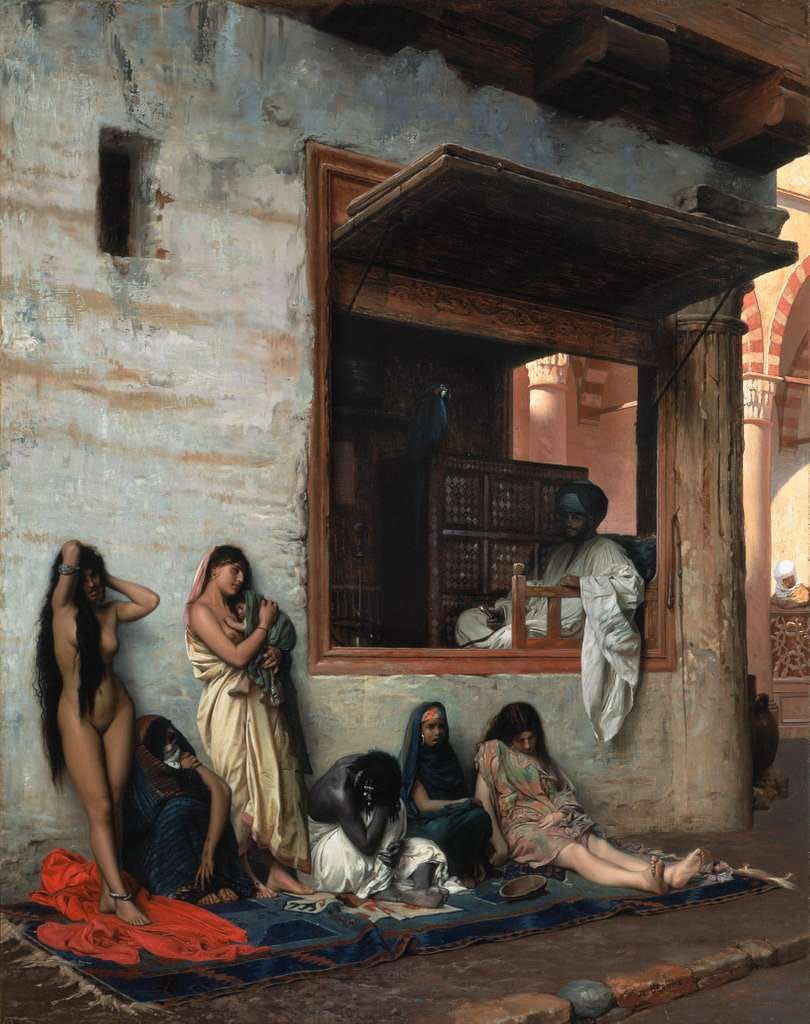
The white slave in Gérôme’s painting stands barefoot on a wooden dais, her shift pulled open to expose her torso. A buyer—turbaned, bearded, impassive—pries her lips apart with his thumb and forefinger, inspecting her bite like a horse at auction. Her eyes are downcast. Her hands hang limp. The transaction is clinical, almost tender. The painter has given her skin a porcelain glow, her hair a cascade of dark silk, her posture the resigned grace of a martyr.
But that mouth. The gesture is the painting’s centerpiece, the moment Gérôme chose to freeze. It is not a kiss. It is not a threat. It is an inventory. The buyer is checking for rotten teeth, for disease, for age. The woman is being assessed as a piece of property, and the painter has rendered this degradation with the loving precision of a jeweler.
The painting is beautiful. That is the horror.
WHAT YOU THINK YOU SEE
The casual viewer—then and now—reads Gérôme’s canvas as a window into the “timeless East.” The scene is set in a vaguely Ottoman market, with tiles, arches, and a crowd of men in robes and fezzes. The women in the background wait their turn, draped in fabrics that suggest wealth and submission. The white slave is the focal point: pale, vulnerable, European. The implication is clear—this is what happens in the Orient. This is how they treat women.
For nineteenth-century European audiences, the painting confirmed everything they believed about the Muslim world: that it was despotic, sensual, cruel, and stuck in a medieval past from which only European intervention could rescue it. The painting was exhibited in Paris, London, and New York, where it was praised for its “ethnographic accuracy.” Critics marveled at Gérôme’s attention to detail—the tiles, the textiles, the posture of the slave dealer. It was, they said, as good as a photograph.
And that is precisely the lie.
WHAT WAS REALLY HAPPENING
In 1866, when Gérôme finished The Slave Market, the Ottoman Empire had already banned the slave trade. The British had been pressuring the Sublime Porte for decades to suppress the traffic in African captives, and in 1857, the Ottomans formally prohibited the Black slave trade. In 1863, the British consul in Constantinople reported that the open slave markets of Istanbul had been closed. The trade that remained was clandestine, small-scale, and increasingly focused on Circassian and Georgian women—the so-called “white slaves” who were trafficked from the Caucasus, often by their own families, into wealthy Ottoman households as concubines or domestic servants.
Gérôme knew this. He had traveled to the Ottoman Empire in 1854 and again in 1857, but he painted The Slave Market in his Paris studio, using models and props. The painting is not reportage. It is fantasy.
The fantasy served a specific political purpose. In the 1860s, France was expanding its colonial empire in North Africa and the Middle East. The French conquest of Algeria was ongoing, and French influence in Egypt and the Levant was growing. To justify colonialism, European audiences needed to believe that the societies they were conquering were morally bankrupt—that they needed saving. The image of a white woman being sold by dark-skinned men was the perfect propaganda: it combined racial hierarchy, sexual threat, and the promise of rescue.
But here is what Gérôme’s painting hides: the Ottoman slave trade was not a spectacle. It was a system.
The women sold in these markets were not random captives. They were often the products of debt, famine, or political instability in the Caucasus. Circassian families sold their daughters into slavery as a form of social mobility—the girl might become the wife or concubine of a wealthy pasha, and her family would receive payment and protection. The trade was brutal, but it was not the open-air bazaar of Gérôme’s imagination. It happened in private homes, through brokers, with contracts and receipts. It was a business, not a carnival.
The painting turns a complex economic crime into a pornographic spectacle. That is its real function.
“The Orientalist painter does not depict the Orient; he invents it. He selects the elements that confirm European superiority and erases everything that complicates the story.” — Linda Nochlin, The Imaginary Orient
But the photograph hides something the people who circulated it never wanted seen: the actual victims of this trade were not the women in the painting—they were the women the painting made invisible.

Gérôme’s painting shows a single white woman on a dais, bathed in light, her body exposed for inspection. But the frame cuts out everything that made the trade real.
First, the African slaves are missing. By 1866, the Ottoman Black slave trade had been officially banned, but it continued illegally. African men, women, and children were trafficked from Sudan, Ethiopia, and the Sahel into Egypt and Arabia. They worked as domestic servants, agricultural laborers, and eunuchs. They were not sold in the decorative markets Gérôme painted. They were sold in back rooms, at night,
