


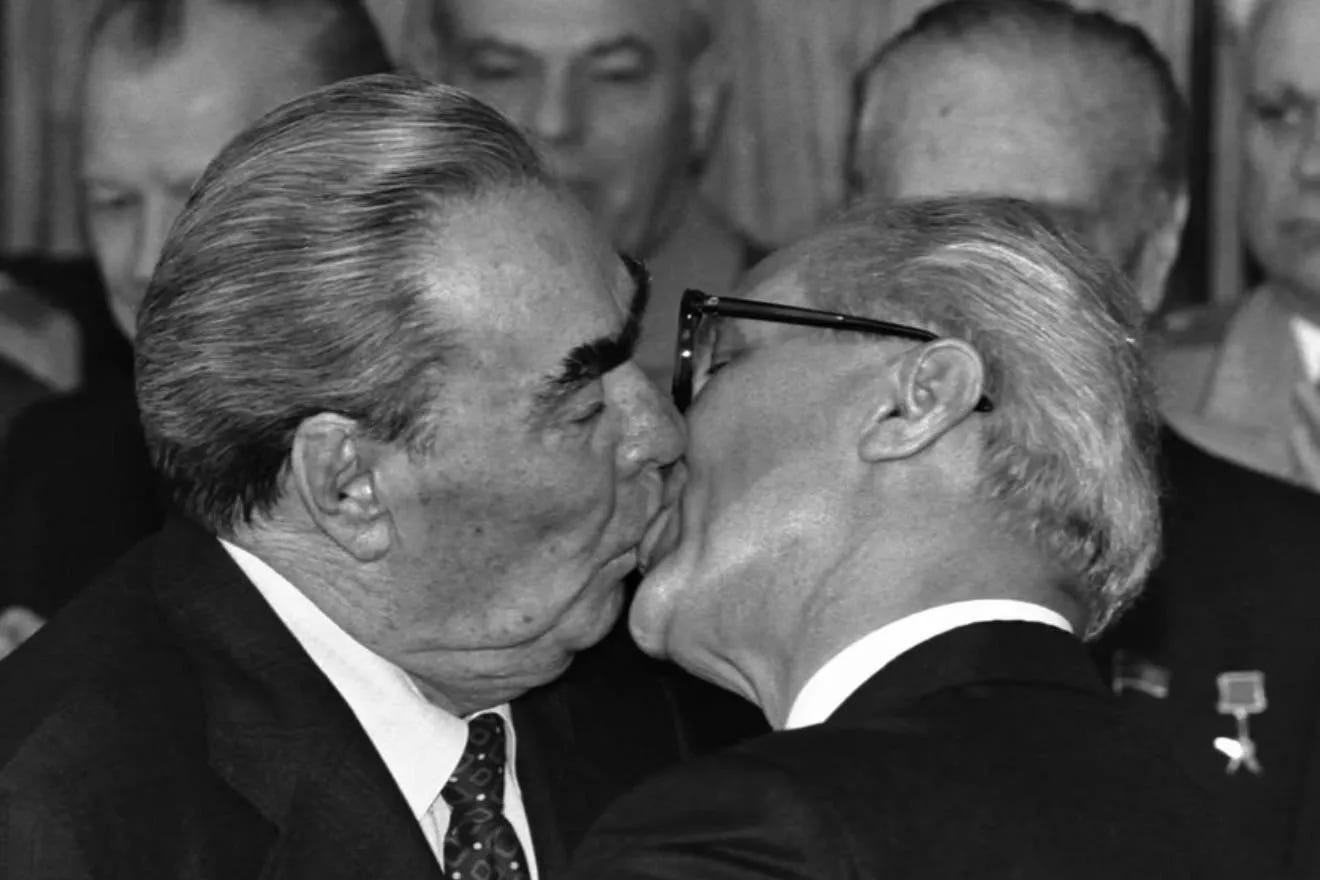
The iconic 1979 embrace between Leonid Brezhnev and Erich Honecker is not merely a ritual of diplomatic solidarity or a moment of absurd theater; it is a biological and political death mask. This investigation argues that the image captures the precise moment the Soviet bloc transformed from an ideological project into a gerontocratic suicide pact, masking the systematic erasure of dissent, the impending economic collapse, and the brutal machinery of the Stasi behind a performance of enforced intimacy.
Intimacy in the halls of absolute power is rarely an expression of affection; it is a biological seal on a political contract, a transference of legitimacy through physical contact that mimics the human but serves the inhuman. The collision of these two figures does not represent a meeting of minds, but the fusion of two calcifying systems desperately propping one another up against the gravity of history. There is a palpable texture of decay in the frame—the sagging skin, the closed eyes, the heavy suits armor-plating failing bodies. This is not the vigor of revolution; it is the rigor mortis of an empire setting in while the subjects are still breathing. To look at this embrace is to witness the physical manifestation of the ‘Era of Stagnation,’ where the only movement left was the involuntary shudder of a dying organism attempting to simulate life.
The Optical Illusion of Absurdity
The casual observer, conditioned by Western irony or post-Cold War relief, often categorizes this image as satire, meme, or grotesque comedy. It is easy to laugh at the spectacle of the ‘Socialist Fraternal Kiss’—a formalized greeting derived from Eastern Orthodox ritual but repurposed by the Politburo. This dismissal is a dangerous intellectual shortcut. Viewing this merely as ‘funny old men’ strips the moment of its terrifying agency. This was a deliberate, high-stakes performance of geopolitical theater occurring on October 7, 1979, the 30th anniversary of the German Democratic Republic. The laughter of the modern viewer serves as a defense mechanism against the reality of what this kiss authorized: the continuation of the Berlin Wall, the suppression of the Polish Solidarity movement (which would ignite months later), and the imminent invasion of Afghanistan. We see a kiss; the citizens of East Berlin saw a padlock snapping shut.
The Architecture of the Lie
The composition is a masterclass in totalitarian aesthetics, accidentally subverted by the camera’s ruthless fidelity. The photographer, Regis Bossu, captured a symmetry that the state propaganda machine deeply desired but could not control. The framing isolates the heads, severing them from the context of the podium, the military parades, and the cheering crowds. By cropping out the machinery of the state, the image inadvertently reveals the vulnerability of the leaders. It highlights the closed eyes—a critical detail. They are not looking at the future; they are retreating into a private darkness, shutting out the reality of the crumbling infrastructure and the simmering unrest just beyond the security perimeter. The kiss was designed to broadcast the ‘unbreakable friendship’ between the USSR and the GDR, a signal to the West that East Berlin was an immutable satellite of Moscow. Instead, the flashbulb illuminated a desperate cling for survival.
The Great Silence: Who Is Not Breathing?
The true horror of this image lies not in the visible embrace, but in the sprawling, suffocating negative space surrounding it. Absent from this frame are the 17 million citizens of the GDR, whose agency is being literally consumed by the two men representing the state. Every pixel of this kiss is paid for by the silence of the Bautzen political prisons. The intimacy displayed here is inversely proportional to the privacy allowed to the average citizen; while Brezhnev and Honecker share a breath, the Ministry for State Security (Stasi) is busy cataloging the scents, letters, and whispers of the population.
Also missing is the specter of the youth. In 1979, the underground punk scene in East Berlin was beginning to curdle into open resentment, fueled by an economic reality that contradicted the celebratory banners of the 30th Anniversary. The men in the photo represent a combined age of over 140 years, governing a populace increasingly alienated by a leadership that physically resembled the crumbling facades of their pre-war buildings. This is a portrait of a generation that refused to cede the stage, kissing itself to reassure itself that it still existed. Furthermore, the economic ledger is invisible but present: the GDR was effectively bankrupt, kept afloat by loans from the very capitalist West they rhetorically despised. This kiss is a transaction where the currency is delusion. The ‘Brotherhood’ celebrated here is a closed loop, excluding the worker, the intellectual, and the dissident, all of whom are rendered non-entities by this totalizing union of the vanguard.
The Mafia of the Proletariat
When viewed through a systemic lens, the ‘Socialist Fraternal Kiss’ operates less like a diplomatic protocol and more like the *Omertà* of a crime syndicate. It is a bond of complicity. In 1979, the Soviet Union was requiring absolute loyalty from its satellite states as its own internal contradictions began to tear it apart. Brezhnev’s embrace of Honecker is the enforcement of a feudal tribute system masked as socialist internationalism. It signaled to the other Warsaw Pact nations that the Brezhnev Doctrine—the justification for military intervention in any socialist country turning toward capitalism—was still in full effect. The kiss legitimized the systemic extraction of East German industrial output to the Soviet Union and the reciprocal export of Soviet military hegemony to East Germany. It was a visual contract stating that the sovereignty of the GDR was a fiction; there was no East Germany, only the westernmost extension of the Kremlin’s nervous system.
The Echo of the Wall
The afterlife of this image confirms its toxic potency. When Dmitri Vrubel later painted this scene on the Berlin Wall under the title ‘My God, Help Me to Survive This Deadly Love,’ he was not creating a caricature; he was performing an exorcism. The transition from a press photograph in a state newspaper to a mural on the very barrier that imprisoned a population marks the collapse of the image’s intended power. However, the echo remains relevant. It serves as a stark reminder of how authoritarian regimes utilize performative emotion to mask structural violence. The modern parallel is not found in kisses, but in the firm handshakes and staged camaraderie of contemporary autocrats who perform stability for cameras while their internal systems rot. The medium changes, but the message—that the bond between leaders supersedes the will of the governed—remains the fundamental grammar of tyranny.
The Unsettled Reflection
We are left with a disquieting philosophical residue: the realization that the most dangerous political acts are often framed as gestures of love, brotherhood, and protection. The terror of the Brezhnev-Honecker embrace is not that it is cold, but that it feigns warmth. It forces us to question the nature of political imagery—are we looking at history, or are we looking at the mask history wears to hide its atrocities? The kiss forces the viewer to confront the uncomfortable truth that monstrous systems are maintained not just by guns and walls, but by human relationships, by loyalties, and by the terrifyingly intimate agreements made by old men in closed rooms, breathing each other’s air while the world outside holds its breath.