


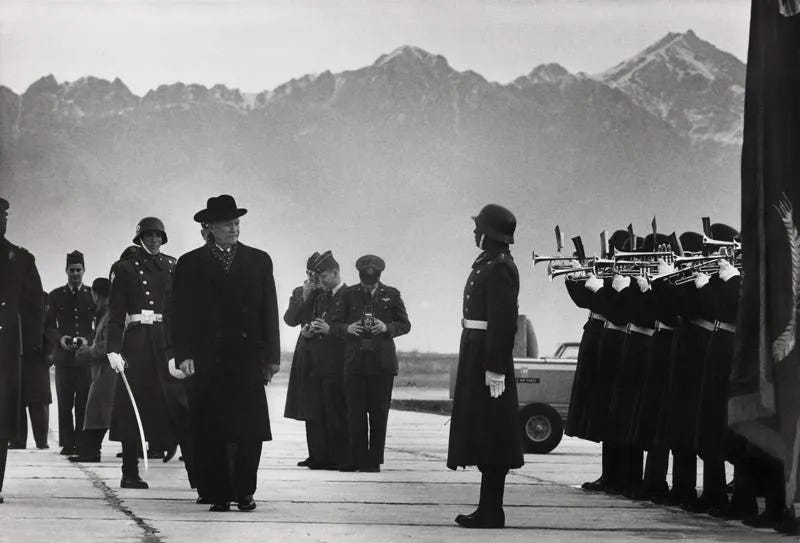
The air at Bagram has always been thin, but on December 9, 1959, it was thick with a specific kind of geopolitical deceit. Here stands Dwight D. Eisenhower, the thirty-fourth President of the United States, a man who commanded the greatest armada in human history, now standing on a tarmac that would eventually become the tombstone of American hegemony. He is not wearing a uniform. He is draped in the heavy wool coat of a statesman, a Homburg hat perched on his head like a crown of civilian respectability.
He is walking past an honor guard in the shadow of the Hindu Kush, mountains that have swallowed Alexander the Great, the British Raj, and eventually, the Soviet Union. But in this freeze-frame, the tragedy hasn’t started yet. Or so it seems. To the untrained eye, this is a handshake tour; to the historian, it is a crime scene photo taken thirty minutes before the murder.
It was a five-hour stopover. Five hours to secure a legacy, to charm King Zahir Shah, and to place a chip on the roulette table of Central Asia. The image is hauntingly crisp. The stark black and white photography strips away the dusty browns of the Afghan landscape, leaving us with a binary world: us versus them, order versus chaos, the suit versus the uniform. But look closer at the edges of the frame. The horizon is jagged, indifferent to the pomp of the foreground.
“The diplomat knows that in the game of empires, the ground beneath your feet is never truly yours; it is merely rented from the mountains.”
Eisenhower looks serene, perhaps even fatherly. He projects the aura of a grandfather visiting distant relatives, not a Cold Warrior inspecting a buffer state. But make no mistake: this is the high-altitude chill of the Cold War. He is here because the Soviets are next door. He is here because the vacuum of power is intolerable to the architecture of the West. This image is the prologue to a sixty-year narrative of intervention, betrayal, and bloodshed that would eventually see American C-17s lifting off from this very concrete, desperate bodies falling from their wheel wells. But in 1959, the runway is clean. The lines are straight. The illusion of control is absolute.
01 // The Surface Observation
At first glance, the photograph presents a masterclass in diplomatic choreography. The blocking is precise. The President is the gravitational center, moving left to right, driving the narrative forward. The Afghan honor guard stands rigid, a wall of discipline meant to mirror the stability of the monarchy itself. The mountains in the background provide the operatic scale required for such a meeting—this isn’t just a meeting of men; it’s a meeting of nations against the backdrop of eternity.
However, the visual language betrays a deeper dissonance. We are looking at a man who defeated the Nazis, being saluted by soldiers wearing helmets that are suspiciously similar to the German Stahlhelm. The Afghan military, influenced by pre-war German training and equipment, presents a jarring aesthetic echo for the Supreme Allied Commander. Does Ike notice? Does he care? Or is the uniform just another costume in the theater of statecraft?
The photographers in the background are crucial. They are not merely documenting; they are part of the apparatus. They are the lens through which the American public will be told that Afghanistan is a friend, a modernizing nation, a safe harbor. They are capturing the ‘Appearance of Reality’—a construct where a handshake solves geography. The stark lighting casts long shadows, suggesting it is either early morning or late afternoon—a twilight time.
The texture of the image—the grain of the film—feels almost tactile, like the grit of the Bagram dust. Eisenhower’s coat is buttoned tight, a shield against the elements and perhaps the uncertainty of the environment. He holds his gloves, a gesture of gentility. He is not armed, yet he represents the greatest nuclear arsenal on earth. The appearance is one of benign power, but the reality is that power is never benign when it travels halfway across the world to assert itself.
02 // The Architect’s Intent
This image was not accidental; it was engineered. It was captured during Eisenhower’s “Peace and Friendship in Freedom” tour, a massive diplomatic blitz across eleven nations. The intention was to demonstrate American reach without American aggression. The White House press corps and the US Information Agency needed imagery that sold ‘partnership.’
Notice the framing. The photographer has positioned themselves low, looking up slightly, elevating Eisenhower and the soldiers against the majesty of the mountains. This is the ‘Heroic Angle.’ It is designed to minimize the vast, empty, and ungovernable spaces of Afghanistan and maximize the human elements of order.
Propaganda is most effective when it looks like a snapshot. The candid nature of Eisenhower walking is a calculated informality. It suggests movement, progress. A static pose would suggest stagnation. The designers of this moment wanted the American public to see a President who was active, engaged, and physically present on the frontiers of freedom.
“History is a gallery of curated lies, and the photographer is the curator.”
They wanted to counter the imagery of Soviet Premier Nikita Khrushchev, who had visited Kabul earlier. The Soviets were building roads and silos; the Americans needed to show they were building relationships. This photo is a counter-argument in silver halide. It screams: *”We are here. We matter. And these people respect us.”* The intended audience was not the Afghan peasant, who would never see this photo, but the suburban American voter and the Soviet politburo. It was a signal sent on two different frequencies.
03 // The Shadow Records
Peeling back the layers of this image reveals a rot that the silver nitrate cannot capture. In 1959, Afghanistan was officially neutral, but it was already being torn apart by the gravity of two dying stars.
While Eisenhower smiled at Bagram, the structural integrity of the Afghan state was brittle. King Zahir Shah and his cousin, Prime Minister Daoud Khan, were playing a dangerous game—accepting Soviet military aid to modernize their army (the very men standing in that line) while courting American development aid for infrastructure. Eisenhower is inspecting a military force paid for by his enemy. The rifles, the tanks out of frame, the training—much of it was Soviet-bloc. The irony is suffocating.
Furthermore, the “modernization” that Eisenhower was there to applaud was a thin veneer in Kabul, completely disconnected from the tribal realities of the rural Pashtun hinterlands. This disconnect created the pressure cooker that would eventually explode in the 1978 Saur Revolution.
Consider the invisible actors. The CIA was already deeply interested in this region, not for its people, but for its proximity to Soviet missile testing sites. This visit wasn’t just about friendship; it was about securing the listening posts. Bagram itself was an American construction project—an airport built by the US in the 1950s, nominally for civil aviation, but designed with runways thick enough for heavy bombers.
We are looking at the groundbreaking ceremony for a fifty-year war. The hidden reality is that the ‘Peace and Friendship’ tour was the lubricant for the military-industrial expansion Eisenhower himself warned against. He stands there, the prophet of the complex, actively expanding its perimeter. The men in the background, the press, the aides—they are the retinue of an empire that doesn’t know it’s walking into a trap.
The tragedy of this image is not what is present, but what is absent: the future. The millions of refugees, the landmines, the drone strikes. They are all waiting just beyond the timeline, invisible but inevitable.
04 // Systemic Analysis
Bagram Airfield in 1959 represents the apex of ‘High Modernism’—the arrogant belief that Western technology and administrative order could tame any landscape and any society. This image is a testament to the System of Containment. Afghanistan was the buffer state, the Switzerland of Asia, and the System required it to remain stable.
The broader system at play here is the dual-track diplomacy of the Cold War. On one track, the handshake and the photo op. On the other track, the covert funding and the arms race. This photo captures the sanitized version of the System. It hides the messy, brutal mechanics of influence.
Moreover, it highlights the transition of Global Policing from the British Empire to the American Republic. The British had learned the hard way that you cannot hold these mountains. The Americans, blinded by their own technological superiority and moral certainty (fresh from WWII victory), believed they could succeed where the Raj failed.
Empires don’t die because they lack power; they die because they mistake their map for the territory. Eisenhower’s presence here affirms the American commitment to a global order where every patch of dirt must be aligned with Washington or Moscow. There is no neutral ground in the System. Even the silence of the Himalayas is politicized.
05 // Modern Echoes
To view this image today is to feel a physical sickness. Bagram Airfield became the beating heart of the US occupation of Afghanistan from 2001 to 2021. It was a city within a city, a fortress of Burger Kings and torture chambers, a place where the American dream collided violently with Afghan reality.
When we look at Eisenhower walking calmly across this tarmac, we cannot help but superimpose the images of August 2021. We see the desperate crowds breaching the perimeter. We see the C-17s taxiing through a sea of humanity. We see the collapse.
Eisenhower’s visit was the opening bracket; the 2021 evacuation was the closing bracket. Everything between those two moments—trillions of dollars, hundreds of thousands of lives—evaporated into the same thin air that Ike is breathing in this photo.
This image is relevant because it documents the innocence of interventionism. It reminds us that every quagmire begins with a handshake and a photo op. It warns us that the ‘strategic importance’ of a region is often a delusion that costs blood. The relevance is cautionary: Beware the clean start. Beware the calm airfield. It is usually the staging ground for a century of chaos.
Eisenhower likely left Bagram feeling accomplished. The crowds had cheered (or been told to cheer). The King was gracious. The photos were excellent. He boarded his plane, the *Columbine III*, and flew away, leaving the dust to settle.
But the dust never really settles in Afghanistan; it just waits for the next wind.
As we close the file on this image, we are left with the chilling realization that history is not a line, but a loop. We build the airfields, we inspect the troops, we smile for the cameras, and then, inevitably, we leave. The mountains in the background haven’t moved an inch. They have watched Eisenhower come and go, just as they watched the Soviets, just as they watched the Taliban, just as they watched the last American soldier turn off the lights at Bagram.
“The only thing we learn from history is that the mountains always win.”