


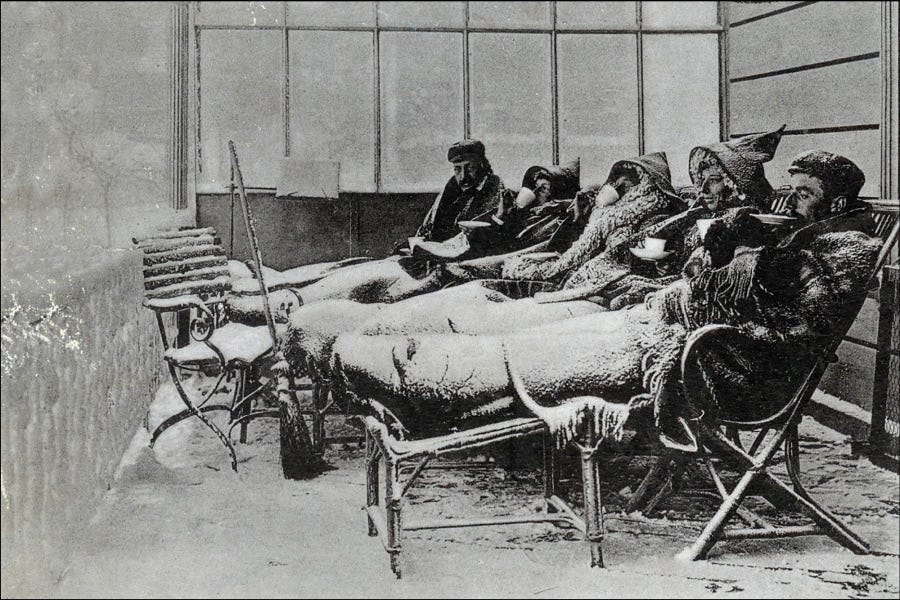
The Terrace, the Blankets, the Silence
Look at the blankets first. Camel-hair, tucked to the chin with a precision that suggests a nurse’s hands, not a patient’s. Forty, fifty bodies in a row, reclining chairs angled at the same degree toward the same peaks, like sundials calibrated to worship. Nobody is talking. Nobody is looking at the camera. Their eyes — the ones open — are fixed on the Alps with an expression that could be reverence or could be the particular blankness of people who have been told to sit still and breathe for six hours and have stopped resisting the instruction.
This is the image the postcard industry sold to the world: convalescence as elegance, illness as leisure, dying as a scenic activity performed at altitude. It is the photograph that furnished Thomas Mann’s imagination when he sent Hans Castorp up the mountain in 1912 for a three-week visit that became seven years. It is also, structurally, an advertisement — and nobody in the frame was in a position to say no to being in it.
The Cure That Looked Like a Vacation
The casual reading is seductive precisely because it flatters everyone involved. We look at the terrace and see the belle époque at its most photogenic: aristocrats and industrialists’ daughters, wrapped in furs, healing themselves through mountain air, rest, and the sheer force of good breeding. The story we’ve absorbed — through Mann, through a century of Alpine tourism branding, through the postcards themselves — is that Davos was a wellness retreat before wellness retreats existed. Rich Europeans with delicate lungs decamped to the mountains, took the “cure,” played chess, fell in love, debated Settembrini-versus-Naphta politics in drawing rooms, and either recovered or didn’t, gracefully, with a view.
The assumption baked into this reading is that the terrace chair was a treatment. That the silence was peace. That the waiting — and everyone in that photograph was waiting, for a doctor’s verdict, for a temperature reading, for a letter — was simply the tempo of leisure, not the tempo of a sentence being served.
But waiting for what, exactly? The people in that photograph were not waiting for a mountain sunset. They were waiting for a number on a thermometer to decide whether they would ever go home — and the machinery built around that waiting was far less romantic than the view.

Subscribe to see what the postcard cropped out: the death ledgers, the class system inside the cure, and the doctor who owned half the town.
