


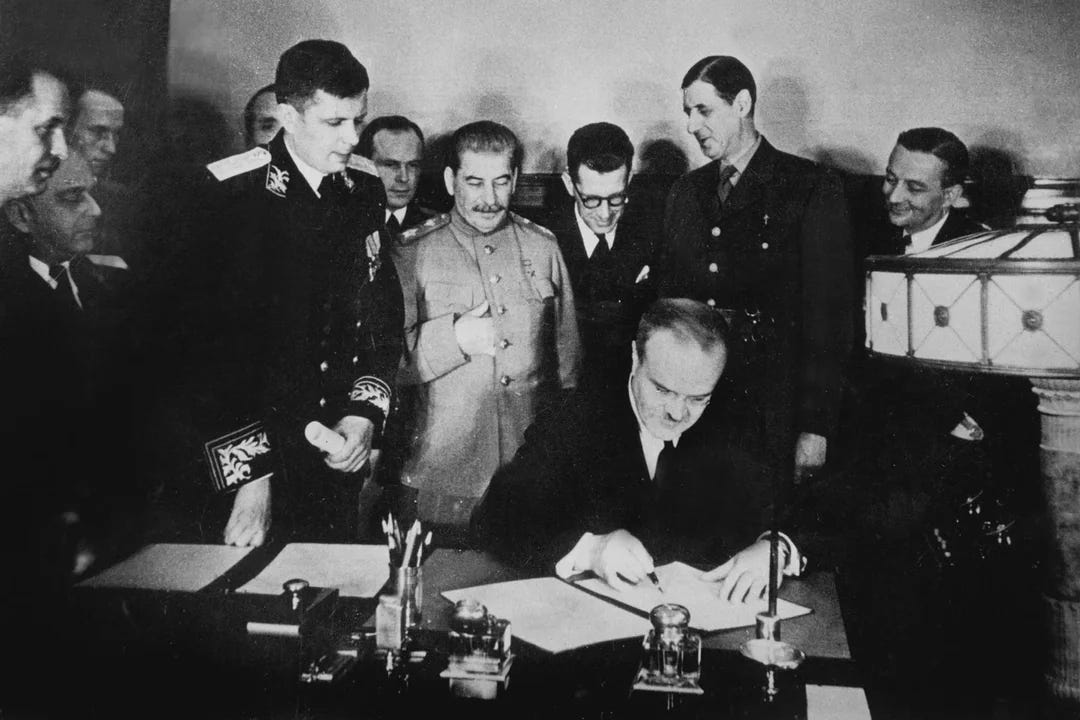
The air in the Kremlin is thick, not just with the smoke of Soviet tobacco, but with the suffocating weight of a geopolitical gamble that would define the next half-century. It is December 10, 1944. The man seated and scratching his signature is Vyacheslav Molotov, Stalin’s ruthless hammer of foreign policy. Looming over him, looking almost bemused, is Joseph Stalin himself. To the left, rigid as a statue in his uniform, stands General Charles de Gaulle.
On the surface, this is a signing of the Franco-Soviet Treaty of Alliance and Mutual Assistance—a pact against Nazi Germany. But beneath the ink lies a desperate, high-stakes poker game played by a French general holding a hand of empty cards against a Soviet dictator holding all the chips. This is not a meeting of friends; it is a collision of two colossal egos using each other to spite the absent Americans.
The Surface Observation
At first glance, the photograph projects the solidarity of the Allied powers. We see the formal apparatus of statecraft: the heavy desk, the ornate lamp, the uniformed dignitaries, and the ceremonial signing. It appears to be the restoration of France to the table of Great Powers, welcomed by the Soviet Union. De Gaulle looks authoritative, Stalin looks cooperative, and the mood seems to be one of grim determination against a common fascist enemy.
“Politics is the art of using men who think they are using you.”
However, this visual narrative is a meticulously crafted illusion. The composition disguises the reality of a beggar at the king’s court. De Gaulle is not there as an equal; he is there because he has been sidelined by Roosevelt and Churchill, and he is frantically seeking a counterweight in the East to prove France still matters.
The Architect’s Orchestration
The framing of this image is pure Soviet theatre. Note the positioning: Molotov does the work, subservient and seated. Stalin stands centrally but slightly back, occupying the ‘architect’ position—he is the unmoving mover, the gravity around which the others orbit. By allowing this photograph to be taken and disseminated, Stalin achieved a dual propaganda victory. First, it legitimized his expanding sphere of influence in Eastern Europe by securing French recognition. Second, it drove a wedge into the Western alliance before the war even ended. For De Gaulle, the photo was designed to be consumed in Paris and Washington: a visual declaration of independence that shouted, “France is not an American colony; we chart our own course.”
The Shadow Records
The frame excludes the ghosts haunting this room. The true subject of this negotiation wasn’t Germany; it was Poland. Stalin spent days bullying De Gaulle to recognize the Soviet-puppet Lublin Committee as the legitimate government of Poland, effectively betraying the Polish government-in-exile in London. De Gaulle, desperate for the treaty but morally torn, nearly walked out multiple times.
The hidden reality is that the document Molotov is signing was bought with the freedom of Eastern Europe. Furthermore, the atmosphere was reportedly bizarre and menacing. During the banquets surrounding this visit, Stalin engaged in terrifying toasts, drinking to the “machine gunners” and joking about hanging his own generals if they failed—a display of brute power designed to rattle the refined French delegation. The ink on the paper was barely dry before Stalin dismissed the French relevance entirely; at Yalta, just two months later, De Gaulle wasn’t even invited.
Systemic Analysis
This image captures the messy birth of the Cold War order. It illustrates the friction between *Raison d’État* (national interest) and moral ideology. De Gaulle, a devout Catholic and a man of the right, is aligning himself with the atheist, communist totalitarian state. Why? Because the broader system of international relations dictates that sovereignty is more important than consistency. This moment is a precursor to the Westphalian tragedy of the 20th century: the realization that the ‘Allies’ were merely co-belligerents with incompatible visions for the future. It demonstrates how the Soviet system utilized diplomatic ceremony as a narcotic, lulling nations into agreements that would later be used as leverage for territorial expansion.
Modern Reverberations
The echoes of this meeting resonate loudly in contemporary French foreign policy. The concept of “Strategic Autonomy”—the idea that Europe (led by France) must be independent of the United States—was born in rooms like this. When modern French presidents travel to Moscow to mediate alone, often to mixed or disastrous results, they are reenacting De Gaulle’s pilgrimage. It serves as a stark warning about the limitations of personal diplomacy with authoritarian regimes. The belief that one can charm or out-maneuver a dictator through protocol and treaties is a delusion that history repeatedly shatters.
The treaty signed in this photo was unilaterally annulled by the Soviet Union in 1955. In the long arc of history, the paper meant nothing. What remains is the image of the General and the Dictator—one standing for a nation’s resurrection, the other for its subjugation—locked in a frame of mutual deception. It forces us to ask an uncomfortable question: How much moral compromise is acceptable to save a nation’s pride? De Gaulle shook the hand of the devil to save the soul of France, but looking at the smirk on Stalin’s face, one has to wonder who really won the soul.