


The accepted history of the ‘nation-state’ established in 1648 is a comforting fiction that John Cary’s 1799 map violently disproves. We have never truly lived in a world of clean borders; we lived in a brief anomaly of simplified geography. By examining the chaotic, fractal sovereignty of the Holy Roman Empire’s final days, we find the only accurate roadmap for our digital future: a return to the gradient, the Marcher Lord, and the overlapping jurisdiction. The era of the Line is dead; the era of the Zone has returned.
To look upon John Cary’s 1799 *New Map of the Circle of Westphalia* is to witness the autopsy of a lie. We are taught that the Peace of Westphalia in 1648 birthed the modern international system—the concept that borders are absolute, sovereignty is total within those borders, and the state is the sole arbiter of violence. Yet, one hundred and fifty years after that supposed geopolitical singularity, the very region that gave the treaty its name remained a kaleidoscope of feudal vomit. The map is not a grid of nations; it is a tangled pathology of Bishoprics, Duchies, and Imperial Cities that defies the clean geometry of modern governance.
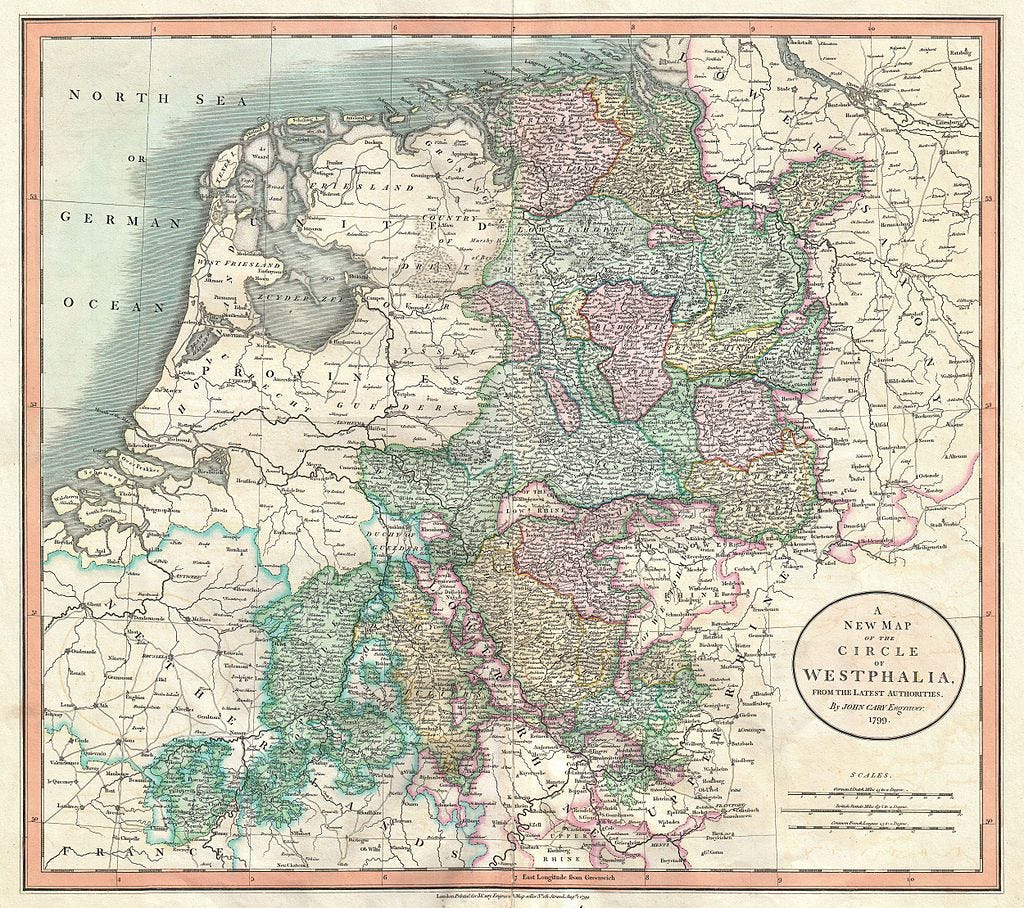
This cartographic chaos reveals that the ‘border line’ was never a historical reality, but a modernist imposition—a hallucination of control projected onto a world that functioned on relationships, not geometry. In 1799, a traveler moving from Munster to Osnabruck did not cross a line; they traversed a gradient of fading authority. They moved from the ‘King’s Peace’ of one sovereign into the murky, contested zones of Marcher Lords. We assume borders are lines in the sand, but history shows they were usually gradients of power. The illusion of the hard border was a temporary technological limitation of the 20th century, and that anomaly is now collapsing.
The state did not invent the border to separate people; it invented the border to monetize them. When the line blurs, the tax base evaporates.
The Marcher Lord and the Architecture of the Zone
In the fractal geography of the Holy Roman Empire shown here, power was not uniform. It radiated outward from a castle or a cathedral, decaying with every mile traveled until it overlapped with the radiating power of a rival neighbor. These overlapping zones were the domain of the Marcher Lord—the semi-autonomous warlord or Bishop who thrived in the ambiguity between sovereigns. The frontier was a zone, not a line; it was a marketplace of competing jurisdictions where law was negotiable and protection was a racket.
Look closely at the Bishopric of Paderborn or the Duchy of Westphalia. These are not coherent states. They are network nodes. The authority here was personal, not territorial. You paid taxes to whoever could reach you with a pike. If two Lords could reach you, you paid both, or you played them against one another. This is the precise geopolitical architecture re-emerging in the digital sphere. We are seeing digital Marcher Lords rise—platforms and protocols that exert sovereign-style power over populations that geographically reside in ‘nation-states’ but digitally reside in the cloud.
The Digital Marcher Lord—be it a decentralized protocol, a transnational cloud provider, or a encrypted sovereign community—operates exactly like the Prince-Bishops of 1799. They hold territory that is everywhere and nowhere. They extract tithes (data/subscription) in exchange for the ‘King’s Peace’ (moderation/security). Law has returned to being personal, not territorial; your rights depend on which user agreement you signed, not which soil you stand on.
The Outlaw and the Interstitial Vacuum
The brilliance of Cary’s engraving lies in what it attempts to organize but fails to contain. The white spaces, the river bends, the jagged edges of the *County of Mark*—these were the spaces of the outlaw. In a system of rigid borders, the outlaw is a criminal who must flee to another jurisdiction. In a system of gradients, the outlaw is simply someone who exists in the static between signals. The ‘King’s Peace’ only extended so far; beyond that radius lay outlaw country, not because it was empty, but because it was illegible to the center.
We are currently witnessing the expansion of this illegible zone. As the nation-state attempts to enforce 20th-century lines on 21st-century networks, the ‘outlaw’ becomes the default status of the digitally sovereignty-minded individual. Encryption is the geography of the new Westphalia. It creates pockets of the map where the Emperor’s writ does not run. The return of the zone means the return of the sanctuary; the ability to disappear is no longer about physical flight, but about navigating the overlapping opacities of rival jurisdictions.
To be ‘law abiding’ in a world of overlapping maps is a mathematical impossibility. When three empires claim your allegiance, you are a traitor to at least two of them by default.
The Cartography of Networked Feudalism
Maps from 1500 to 1800 look remarkably like modern network graphs because they depict the same thing: a web of obligations rather than a container of atoms. The rigid color-coding Cary attempts to use is a desperate bid to impose rationalism on feudalism. He is trying to make the chaos legible to the English mind, which had already succumbed to the seduction of the centralized state. But the reality on the ground in 1799 was that sovereignty was a stack, not a surface. A peasant could owe labor to a Knight, spiritual obedience to a Bishop, and taxes to an Emperor, all of whom claimed the same plot of dirt.
This is the ‘Stack’ described by modern geopolitical theorists, visible on parchment two centuries prior. We are not moving toward a new world order; we are reverting to the mean. The Westphalian ‘Line’ was a brief interregnum where we pretended that a single entity could monopolize power over a specific geography. The internet has shattered the monopoly on violence and replaced it with a monopoly on verification.
Maps of the future will not show countries; they will show heatmaps of influence and connectivity. The Digital Sovereignty Researcher must stop looking for the border crossing and start looking for the handshake. The ‘state’ is becoming just one node in a mesh of competing authorities, no more supreme than the Duchy of Cleves was against the might of the surrounding empires.
Strategic Foresight: The Gradient is the Strategy
For the analyst, the lesson of 1799 is that stability is found in the center of the node, but opportunity is found in the gradient. The Marcher Lords of Westphalia were often wealthier and more autonomous than the subjects of the deep interior because they could arbitrage the competing powers. Today, the individual or corporation that positions itself solely within the jurisdiction of a single failing nation-state is the equivalent of the serf in the central plains—fully taxable, fully capturable.
The strategic imperative is to position oneself in the *March*. To reside in the overlap. To hold assets in one jurisdiction, identity in another, and physical presence in a third. Don’t trust the line; it is a fiction designed to keep you stationary. The map of the future favors the mobile, the encrypted, and the ambiguous.
We are re-feudalizing the world, not through the collapse of civilization, but through the complexity of it. The complexity of the code has surpassed the capacity of the constitution.
History does not repeat, but it rhymes. The map of Westphalia is not a relic; it is a prophecy. The lines are fading. The zones are expanding. The Marcher Lords are booting up.