


Collapse is rarely a singular explosion, but a calculated administrative withdrawal. By analyzing Thomas Cole’s ‘Destruction’ through the lens of the 410 AD Rescript of Honorius, we uncover the terrifying mechanics of the ‘Legionary Retreat.’ The state does not die; it simply contracts to the core, leaving the periphery to fracture into neo-medieval warlordism. We are currently living through the denial phase of this abandonment.
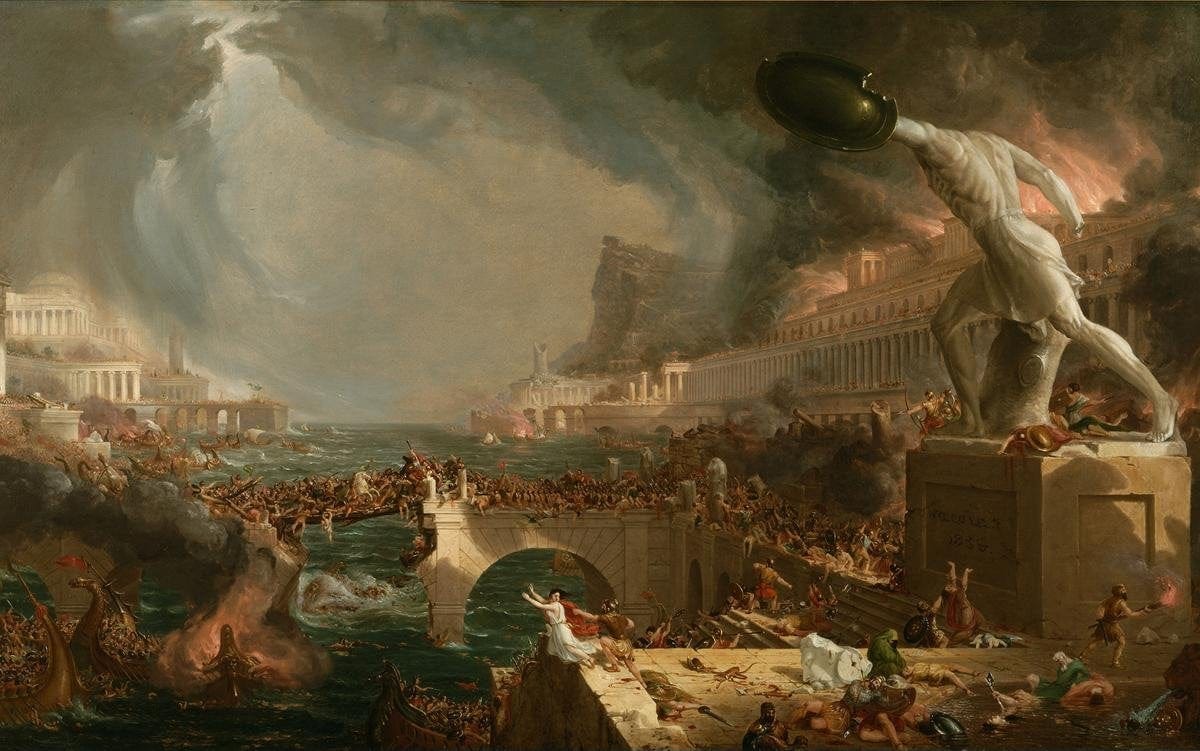
The colossal statue in the right foreground of Thomas Cole’s *Destruction* dominates the eye not because of its majesty, but because of its impotence. It is a headless warrior, shield turned away from the city, guarding nothing. This is the precise visual metaphor for the late-stage imperial condition. The structure of power remains—the marble plinth, the muscular definition of the institutions, the legacy of the name—but the head is gone. The state has not been defeated on the battlefield; it has been decapitated by its own inability to process the complexity of its domain. The chaos swirling beneath the statue is not the result of a superior enemy force, but the natural entropy that occurs when the organizing principle of a civilization simply ceases to function. In 410 AD, when the cities of Britain pleaded with Emperor Honorius for aid against Saxon raiders, his reply was the Rescript of Honorius: ‘Look to your own defenses.’ This was not an admission of defeat. It was a bureaucratic adjustment. The Empire calculated that the cost of maintaining the periphery exceeded the extraction value of the province. Collapse is not a tragedy to the spreadsheet; it is a line-item veto. We stare at this painting and see war; the geopolitical realist sees a budget cut. The legions didn’t die; they were reallocated to the core. The headless statue is the ultimate symbol of a government that has lost its mind but kept its body, flailing wildly as the fires consume the extremities.
The horror of the Rescript is not that Rome was weak, but that Rome was rational. Abandonment was the only way to save the administrative core.
The Bridge and the Bottleneck: Infrastructure as Triage
Observe the bridge collapsing under the weight of the fleeing populace. In the logic of imperial retreat, infrastructure is the first casualty of the ‘Honorius Protocol.’ Bridges, roads, and aqueducts require a centralized maintenance budget that a contracting empire can no longer justify for non-essential zones. When the center cannot hold the periphery, it does not politely inform the provinces; it simply stops repairing the bridge. The collapse in the painting is structural, but the cause is financial. We are witnessing the physical manifestation of deferred maintenance. In our modern context, this is the pothole that becomes a sinkhole, the power grid that flickers during a heatwave, and the police precinct that stops answering calls after midnight. The Roman Retreat is a slow, quiet leaving. It is the withdrawal of the guarantee of safe passage. The people on that bridge believed in the continuity of the state up until the very moment the stone gave way beneath their sandals. They are the victims of the ‘lag time’ between the state’s decision to leave and the citizen’s realization that they are alone. You are living in a province that has already been written off; you just haven’t received the memo yet. The bridge is a bottleneck, and in the economy of collapse, bottlenecks are where the surplus population is liquidated.
The Psychology of the Abandoned Province
The foreground of Cole’s masterpiece is a study in the psychology of denial turning into panic. These figures are not soldiers; they are civilians who operated under the assumption of Imperial protection. Their posture is one of betrayal. This is the pivotal psychological shift of the Neo-Medieval age: the moment the citizen realizes they are actually a subject of no one. The social contract is voided not by revolution, but by ghosting. The terror on display is the realization that sovereignty has become fractional. The Emperor is in Ravenna (or a bunker in DC), the
