


April 1937 wasn’t just a tragedy; it was a tactical experiment by the Luftwaffe. This deep dive analyzes Picasso’s Guernica not as art, but as a casualty report from the first test of ‘Total War,’ drawing chilling parallels to how modern conflicts in Ukraine and Gaza serve as the R&D department for the next Great Power conflict.
April 26, 1937, was not a battle; it was a data collection exercise. The market town of Guernica held negligible strategic value—no fortifications, no significant armaments factories, and no major troop concentrations. Yet, for three hours, the Condor Legion turned it into a furnace. This was Operation Rügen, a deliberate stress test of the German *Luftwaffe’s* evolving doctrine of terror bombing. General Wolfram von Richthofen didn’t just want to destroy a village; he wanted to measure the psychological breaking point of a civilian population under the weight of incendiary payloads.
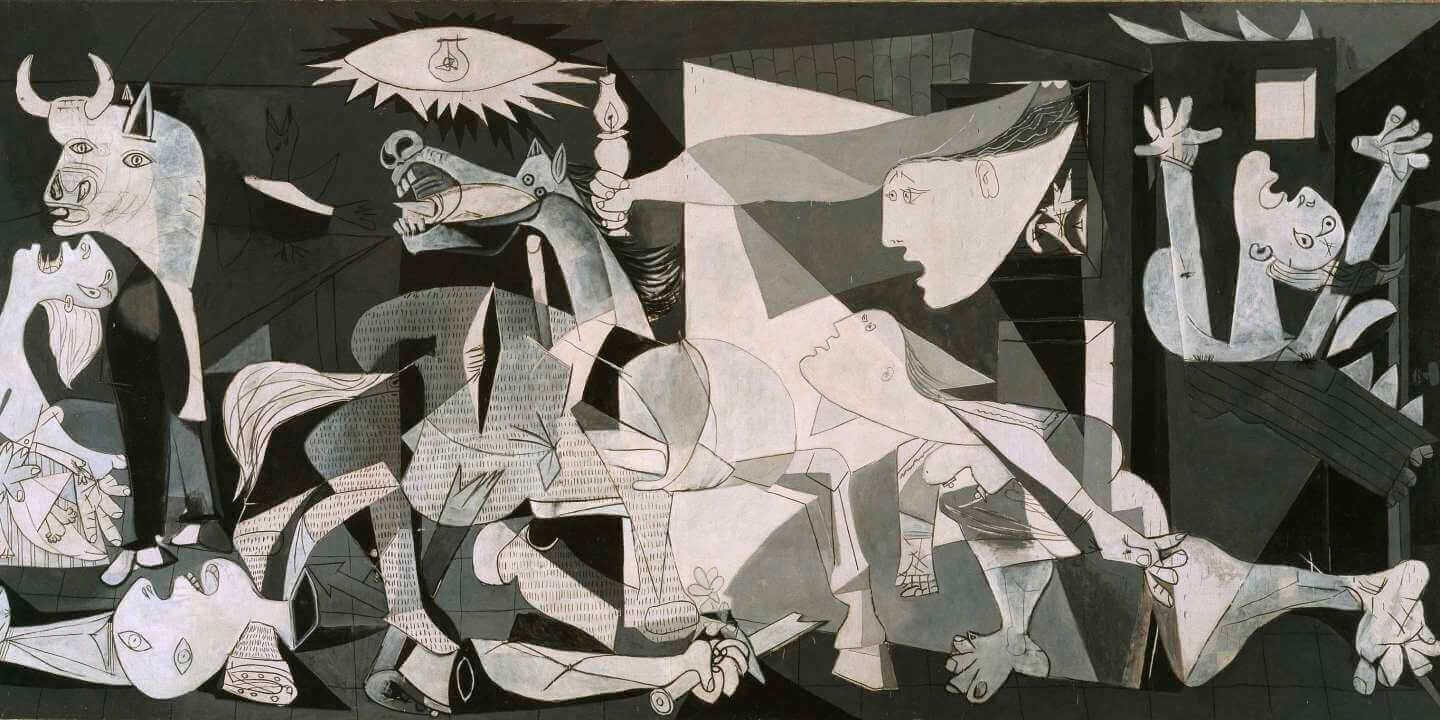
Guernica was the beta test for the Blitz, a cynical proof-of-concept that civilians were now legitimate military infrastructure. The chaos captured in Picasso’s monochromatic nightmare isn’t abstract expressionism; it is a forensic reconstruction of the psychological shock doctrine. The disjointed limbs and screaming mouths are the direct output of a new algorithm of war where the frontline is abolished.
The Spanish Civil War wasn’t about Spain. It was a rehearsal for WWII. We are watching the rehearsals today.
Defense analysts looking at the painting must see beyond the canvas to the tactical reality: the Condor Legion rotated 19,000 German personnel through Spain to ensure their pilots had combat experience before the invasion of Poland. Every scream in Guernica was a data point for the invasion of Europe.
Picasso’s Forensic Report: The Casualty Assessment
The intelligence contained within the frame is as vital as any satellite imagery. The painting is devoid of color because modern warfare drains the blood from the world, leaving only the stark binary of life and death, structure and rubble. The central figure—the horse—is not merely an animal in distress; it represents the utter collapse of the old order of honorable combat. It is the cavalry trampled by the machine.
Notice the soldier lying broken at the bottom, gripping a shattered sword. This is the obsolescence of traditional infantry valor in the face of aerial supremacy. The sword is useless against the Heinkel He 111; the hero is obsolete in the age of industrial slaughter. The light bulb at the top, blazing like an evil eye, mimics the flash of explosives or the interrogation lamp of a police state. It represents technology detached from humanity—the same technology currently guiding hypersonic missiles and AI swarms in today’s ‘sideshow’ wars.
The weapons being tested today will be used globally tomorrow.
Look closely at the woman holding the dead child. This is the ‘pietà’ of the modern era, stripped of religious comfort. There is no divine intervention coming from the sky, only incendiary bombs. This image forces the strategist to confront the collateral reality that sanitized reports call ‘negligible civilian impact.’
The Invisible Aggressor: Asymmetric Warfare
The most terrifying element of *Guernica* is what is missing. There are no planes. There are no pilots. There are no bombs visible in the frame. The aggressor is entirely absent, represented only by the devastation left in their wake. This is the definition of asymmetric, technological warfare. The victims are intimate with their suffering, while the perpetrators are distant, detached, and mechanical.
This invisibility mirrors the current geopolitical landscape. In Ukraine and Gaza, the great powers test their drone swarms, their jamming capabilities, and their missile defense umbrellas without officially declaring war. We are in the ‘Spanish Civil War’ phase of World War III, where the superpowers fight via surrogates to refine their kill chains. Just as the Luftwaffe learned that carpet bombing could break morale (a lesson applied to London and Warsaw), modern militaries are learning how to overwhelm the Iron Dome or jam Starlink.
Watch the ‘sideshow’ wars to understand the future main event.
The terror in the painting is the terror of the unseen hand. The victims in Guernica are looking up, screaming at an enemy they cannot reach, just as modern infantry looks up in terror at loitering munitions.
The Strategic Forecast: The Rehearsal Is Live
History does not repeat, but it rhymes with terrifying precision. The Spanish Republic fell not because it lacked spirit, but because it served as a live-fire range for the fascists’ superior military technology, while the democracies dithered with ‘non-intervention’ policies. Today, we see the same hesitation and the same cynical testing. Every hypersonic strike in Ukraine is a brochure for the next global conflict.
The strategic takeaway for the defense community is unequivocal: ignore the political theater and study the debris. Adjust your threat model based on these live tests, because the specific tactics destroying neighborhoods in proxy wars today will be leveling capitals tomorrow. Picasso painted a warning, not a history lesson. The bull stands on the left, impassive and brutal—a symbol of the relentless, unfeeling nature of fascism and brute force that waits in the wings.
The rehearsal is live. Study the tactics in proxy wars.
If we treat these current conflicts as isolated regional disputes, we are making the same mistake the League of Nations made in 1937. The screams of Guernica were the opening siren of the 20th century’s apocalypse; the drone buzz over the Levant is the siren for ours.
Great analogy; but I think the huge asymmetry is maybe better evidenced in your other example Gaza (and the West Bank too) but really excellent mix of strategic moral and artistic analysis.
Tony