


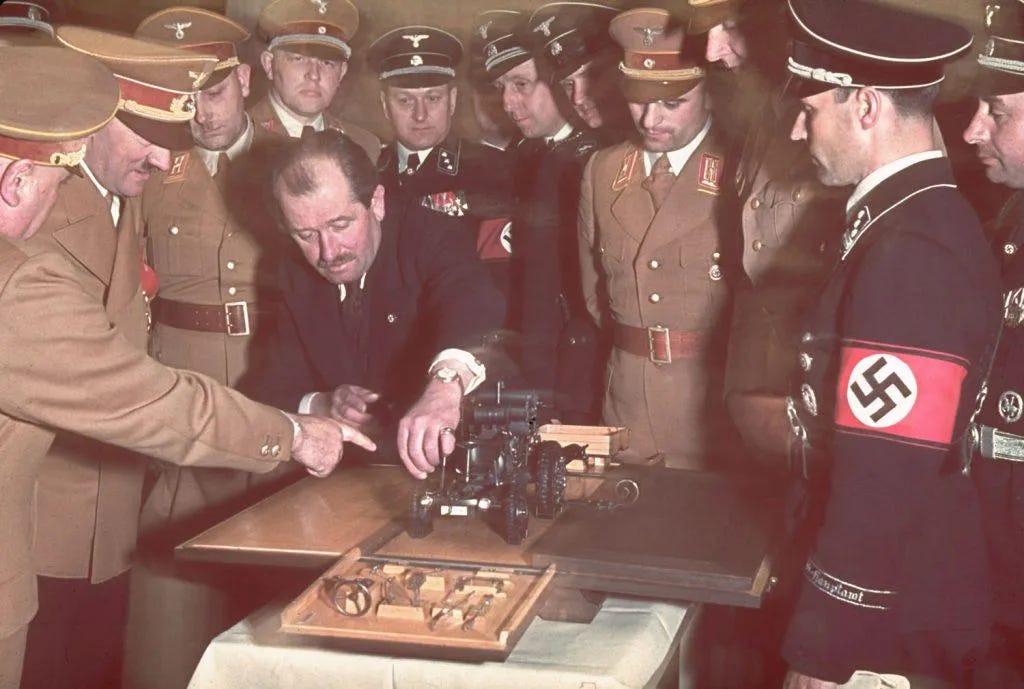
The presentation of the Kdf-Wagen model to Adolf Hitler in April 1939 was not a celebration of automotive innovation, but the sealing of a lethal pact between technocracy and tyranny. This image documents the moment a consumer dream was weaponized to steal the savings of the German working class, fund the machinery of impending total war, and erase the Jewish intellectual lineage of the design, proving that industrial genius offers no immunity to moral bankruptcy.
A toy sits on a polished table. It is small, meticulously crafted, and utterly harmless. Around it, men of immense power gaze downward with the softened expressions of parents looking into a crib. The lighting is warm, capturing the gleam of the miniature fenders and the relaxed posture of the birthday celebrant. There is no blood on the floor. There are no screams echoing from the walls. In this frozen millisecond, the machinery of state terror pauses to admire a mechanism of leisure. It is a terrifyingly domestic tableau. The juxtaposition of the innocent object—a convertible model car—and the men surrounding it creates a cognitive dissonance that acts as a anesthetic. The viewer is invited to appreciate the craftsmanship, to smile at the universal language of gift-giving, and to forget that the table stands at the precipice of the abyss. This is the seduction of the banal. Evil does not always arrive in a cloud of sulfur; often, it arrives in a tailored suit, holding a blueprint for a brighter future, asking for a light.
The Technocrat and the Tyrant
To the uncritical eye, this is a meeting of minds: the political visionary and the engineering genius. Adolf Hitler, celebrating his 50th birthday, stands as the benefactor of the German people, receiving the tangible proof of his promise—the ‘People’s Car.’ Beside him, Ferdinand Porsche, distinguished in civilian attire, points out the technical specifications of the vehicle that bears his engineering soul. It appears to be a triumph of German industry, a moment where the state delivers on its social contract. The surrounding uniformed men, members of the SS and party elite, frame the scene not as a military council, but as a board of directors approving a product launch. The narrative pushed by the image is one of prosperity and modernization. It suggests that the Third Reich is not a war machine, but a factory of dreams, capable of putting a modern automobile in the driveway of every worker. The casual observer sees progress. They fail to see the predation.
The Architecture of Deceit
THE STAGING IS deliberate theater. Note the separation of attire. Porsche is the only man in the focal group wearing a dark civilian suit, a visual anchor of rationality amidst a sea of brown and black uniforms. This visual distinction is crucial propaganda. It signals that the regime has the endorsement of the scientific and industrial elite. Porsche is not merely a guest; he is a prop used to legitimize the men in uniform. By placing the renowned engineer at the center, the regime borrows his credibility. The model car itself is positioned as the protagonist, the bridge between the leader and the led. The composition draws the eye to the hands—Hitler’s and Porsche’s—hovering over the machine. It is a performance of creation. However, the date is April 1939. The invasion of Poland is five months away. This image is not documentation of a car launch; it is documentation of a heist. The theatricality distracts from the reality that the ‘People’s Car’ is a phantom, a financial instrument designed to absorb the liquidity of the working class to float a bankrupt state economy gearing for annihilation.
The Vanished Millions
The most deafening silence in this room comes from the hundreds of thousands of invisible victims who paid for the toy on the table. By this date, over 300,000 German workers had subscribed to the *Sparkarte* system, dutifully paying five Reichsmarks a week into a savings scheme to purchase the Kdf-Wagen. They stuck stamps in their booklets, believing the promise of the man in the brown uniform and the genius of the man in the suit. Not a single one of those subscribers would ever receive a car. The funds—hundreds of millions of Reichsmarks—were not ring-fenced for consumer production; they were hemorrhaged into the general war fund and the construction of the massive Fallersleben factory.
Also missing from this frame is the shadow of the *Kübelwagen*. The chassis Porsche is explaining is not designed merely for family picnics in the Alps. The engineering specifications—the air-cooled engine, the high ground clearance, the rugged suspension—were dual-use by design. While the public was sold a vision of the Autobahn, Porsche and the Wehrmacht were perfecting a vehicle capable of navigating the mud of the Eastern Front and the sands of North Africa. The ‘toy’ is a military scout vehicle in civilian drag. Furthermore, the spectral presence of Jewish engineer Josef Ganz is aggressively cropped from this history. Ganz, the editor of *Motor-Kritik* and a pioneer of the lightweight, rear-engine concept, had his ideas cannibalized by the regime, his career destroyed, and his existence erased so that the ‘Aryan’ genius of Porsche could stand unchallenged. The brilliance on that table is stolen property.
Industrial Feudalism
This image captures the crystallization of the Nazi military-industrial complex. It illustrates the transition from capitalism to command economy feudalism. Porsche represents the captains of industry who convinced themselves that they could ride the tiger of fascism to achieve their technical dreams. He traded his moral autonomy for an unlimited budget and a labor force that would soon cost him nothing but calories. The factory that this model represents would eventually be staffed not by well-paid German guildsmen, but by slave laborers from concentration camps, including the dedicated Arbeitsdorf camp established specifically for the Volkswagen project. The handshake implied in this image is a contract for human chattel. The system requires the complicity of the technocrat; the state provides the power, the engineer provides the efficiency, and the moral cost is externalized to the unseen piles of bodies that will soon accumulate in the factory’s foundations.
The Cult of the Creator
We see the echo of this tableau in every modern worship of the ‘apolitical’ visionary. The reverence for Ferdinand Porsche in this image mirrors the contemporary fetishization of technological disruptors who claim neutrality while contracting with defense departments and surveillance states. We separate the art from the artist, the car from the camp. The Beetle became a symbol of the counter-culture, of peace and love in the 1960s, a testament to how effectively the design was scrubbed of its origins. We drive the legacy of this photo without acknowledging the blood in the transmission. The tension remains: at what point does the pursuit of engineering perfection become a crime against humanity? When does the contract for a ‘user-friendly’ device become a warrant for oppression? The men in the photo knew exactly what they were building. The only confusion lies with us, the observers, who still want to believe it’s just a car.
The Final Calculation
There is no innocence on the table. The model car is a trap. The men are not celebrating a birthday; they are finalizing the logistics of a slaughter. The tragedy is not just that a genius like Porsche collaborated, but that he did so with enthusiasm, viewing the regime not as a burden, but as a prerequisite for his ambition. The true horror of the image is that the brilliance of the machine and the brutality of the man are not opposites, but interlocking gears in the same engine. One could not exist without the other. The car runs on blood.