


The Peace of Westphalia established a 375-year anomaly of state sovereignty that is now collapsing. As the nation-state’s monopoly on violence fractures, we are rapidly reverting to a pre-1648 reality defined by mercenary armies, overlapping jurisdictions, and corporate fiefdoms. Strategic survival now requires ignoring political maps and identifying the functional warlords of the new Neo-Medieval order.
Gerard ter Borch’s rendering of the ratification of the Treaty of Münster is not merely a depiction of peace; it is the birth certificate of the modern illusion. In this crowded, dimly lit hall in Münster, the gathered dignitaries are doing something radical: they are inventing the Nation-State. Look closely at the raised hands.
Those oaths are the precise moment where loyalty shifted from a tangled web of feudal obligations, religious mandates, and guild affiliations to a single, geometric abstraction: the sovereign territory. For nearly four centuries, we have operated under the assumption that the state holds the monopoly on violence, that borders are immutable lines of jurisdiction, and that the map reflects the territory. This was the Westphalian compact—a truce designed to stop the bleeding of the Thirty Years’ War by compartmentalizing power into neat, color-coded boxes.
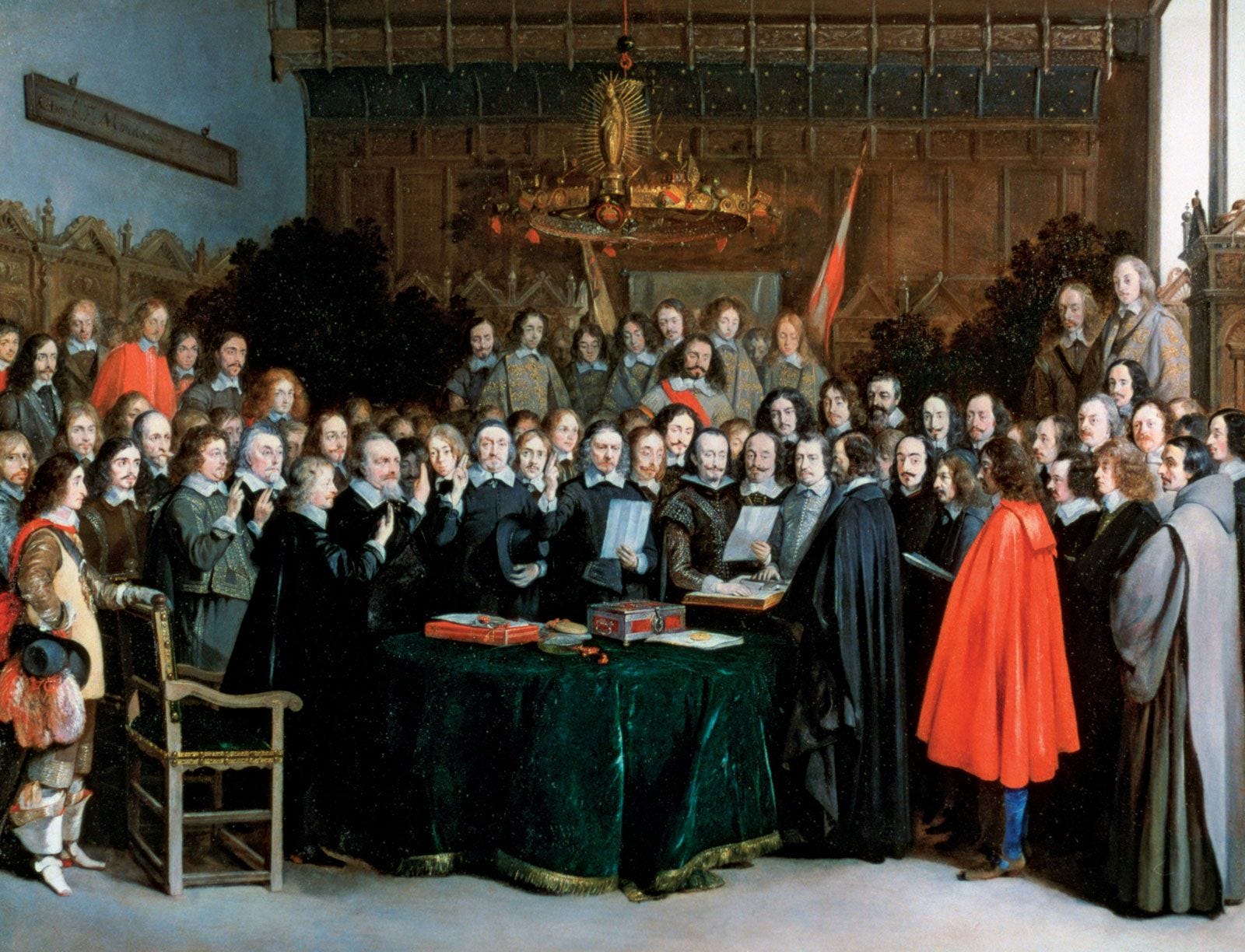
However, the solemnity of Ter Borch’s painting conceals the bloodshed that necessitated it. The Thirty Years’ War was a catastrophe of overlapping authorities where no one knew who truly ruled whom. Today, the Westphalian architecture celebrated in this image is rotting from the inside out. We are living through the liquidation of the Westphalian asset class. The state is no longer the sole protagonist of history; it is merely one distressor in a crowded market of private military contractors, transnational corporations, and decentralized insurgencies. The velvet cloth covering the treaty box in the painting is now a shroud. We are not moving forward into a new era of diplomatic enlightenment; we are sliding backward into the mud that preceded 1648.
The map on your wall is a legal fiction. It depicts a world where governments rule territory, but the reality is a functional chaos where power belongs to whoever can pay the soldiers this week.
The Wallenstein Algorithm: War as Enterprise
To understand the geopolitical risk of the 2020s, one must ignore the politicians in the painting and look for the ghosts of the men who are not there. Specifically, Albrecht von Wallenstein. Before the Peace of Westphalia solidified the state’s dominance, Wallenstein was the supreme entrepreneur of war. He did not fight for patriotism; he fought for profit, raising massive armies that were loyal only to his payroll. He was the CEO of a multinational violence corporation that leased its services to the Holy Roman Emperor. For centuries, historians treated Wallenstein as a barbaric relic of a chaotic past. Today, he is the blueprint for the future. The Private Military and Security Company (PMSC) is not an anomaly; it is the resurgence of the historical norm.
When a state cannot project power 100 miles outside its capital without contracting a private entity to handle logistics and security, it has ceased to be a Westphalian sovereign. It has become a client. We see this in the Sahel, in Eastern Europe, and in the protection of global shipping lanes. The monopoly on violence has been privatized, securitized, and traded on the open market. Sovereignty is fracturing into a service economy where defense is a subscription model, not a citizen’s right.
The danger for the modern analyst lies in assuming that state actors control their proxies. In the pre-1648 world, the proxies often consumed the state. Wallenstein eventually became so powerful that the Emperor had to assassinate him. In our Neo-Westphalian collapse, the ‘Wallensteins’ are tech platforms that control information flow and private militias that control resource extraction. They operate in a sphere of influence that transcends the lines drawn on a map.
The Neo-Medieval Stack: Overlapping Sovereignties
The defining characteristic of the pre-Westphalian world was that a peasant in the Holy Roman Empire served multiple masters: the local lord, the distant Emperor, the Pope in Rome, and the guild in the city. None had total control; all claimed absolute loyalty. This is the precise architecture of the modern condition. The unified sovereignty created in 1648 has shattered into what can be termed the ‘Neo-Medieval Stack.’ A citizen today is subject to the local laws of their physical location, the terms of service of the digital platforms they inhabit, the economic dictates of transnational asset managers, and the ideological pull of non-state actors.
Power is no longer horizontal across a map; it is vertical through a stack of functional authorities. In this environment, the concept of ‘national interest’ becomes incoherent because the nation itself is being cannibalized by functional fiefdoms. We are witnessing the rise of the Corporate City-State and the warlord-administrator. In failed states, the only functioning institutions are often those run by cartels or corporations extracting resources. They provide the roads, the electricity, and the policing. They are the new feudal lords, and the population offers them fealty in exchange for survival, ignoring the nominal government in the capital.
The Peace of Westphalia did not end war; it merely nationalized it. Now that the state is insolvent, war is being reprivatized, and the rules of engagement are being rewritten by market forces rather than diplomats.
Navigating the Collapse: From Legal to Functional Analysis
For the strategic foresight planner, the implications are binary: adapt or hallucinate. Continuing to analyze geopolitical risk through the lens of Westphalian sovereignty—assuming that ‘Germany,’ ‘Nigeria,’ or ‘Brazil’ act as unitary rational actors—is a hallucination. It is an analytical failure to recognize that the painting has been burned. The successful analyst must pivot to ‘Functional Geography.’ This requires mapping the world not by borders, but by supply chains, fiber optic cables, and zones of private control.
Stop looking for the Prime Minister; look for the Paymaster. In a Neo-Westphalian world, legal authority is irrelevant without the functional capacity to enforce it. If a region is nominally under the control of a central government but practically ruled by a local militia funded by illicit trade, the militia is the sovereign. The risk assessment must treat the militia as the state. We are entering an era of micro-sovereignties, where a port facility, a mining complex, or a server farm may have more diplomatic weight and defensive capability than the nation hosting it.
To survive the collapse of the 1648 consensus, one must adopt the mindset of a Thirty Years’ War diplomat. You are not negotiating with stable entities; you are negotiating with shifting coalitions of predators. Stability is no longer guaranteed by international law; it is purchased transactionally from the local warlord.