


A forensic dissection of the East India Company’s operational model, revealing the historical precedent for the modern ‘Corporate State.’ By analyzing the architecture of the East Indiaman vessel, we demonstrate that the separation of public governance and private enterprise is a brief historical anomaly. This investigation argues that the ship before you represents the natural state of power: the Charter Company—armed, sovereign, and beholden only to the shareholder, serving as a chilling roadmap for the future of Big Tech.
The vessel depicted is not merely a mode of transport; it is a geopolitical statement in wood and canvas. This is an East Indiaman, the apex predator of the 18th and 19th-century maritime economy. While it flies the Red Ensign of the British merchant marine at the stern, the true indicator of its nature is the structural ambiguity between commerce and combat. Note the gun ports painted along the hull. These are not decorative. An East Indiaman was built to ‘frigate standards,’ capable of repelling pirates, rival Dutch privateers, and even national navies. It is the physical embodiment of the Charter Company’s central thesis: that trade requires a monopoly on violence.
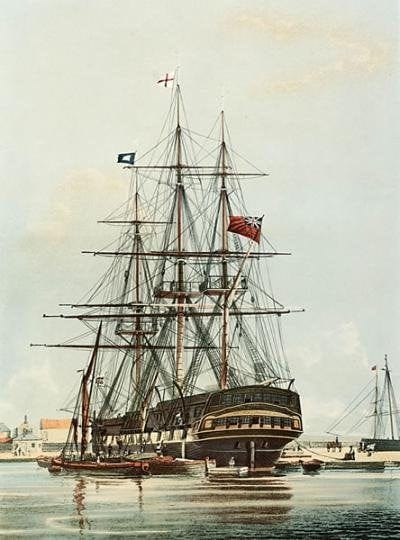
Most historical analyses fail to recognize the audacity of this design. It is a privatization of the state’s most sacred duty—defense. In the hull of this ship, crates of tea and opium sat alongside 18-pounder cannons. There was no distinction between the balance sheet and the battlefield. The East India Company did not conquer nations to spread British law; it conquered them to secure a favorable exchange rate. The ship stands calm in the harbor, yet it represents a radical legal fiction where a board of directors in London could legally wage war, sign treaties, and execute justice thousands of miles away, entirely bypassing the Crown when convenient.
The state exists to protect the citizen; the Company exists to protect the dividend. When the Company becomes the State, the citizen becomes inventory.
We are looking at the ancestor of the private military contractor and the corporate intelligence agency. The rigging may be antiquated, but the operating system is hyper-modern. It posits that efficiency is the only moral good, and that if a corporation can manage logistics better than a government, it should also manage the artillery.
THE STRIPED FLAG AND THE SOVEREIGNTY OF THE LEDGER
At the bow of the vessel, we see a striped jack. This geometric pattern is more than identification; it is a claim of extraterritoriality. The East India Company’s flag—often confused with the Grand Union flag or the early American standard—symbolized a jurisdiction that floated above national borders. When this ship docked in Calcutta or Canton, it did not enter foreign soil; it brought its own soil with it. The ‘Company Raj’ was not a colony in the traditional sense; it was a corporate estate. They minted their own rupees. They established their own courts. They maintained an army that, at its height, dwarfed the official British Army.
Sovereignty is not a divine right; it is a product you buy when you have enough capital to ignore the local magistrate.
This distinction is vital for the post-democratic strategist. We observe modern tech giants struggling against the regulatory frameworks of the EU or the US, but the East Indiaman suggests the inevitable workaround: the creation of a new jurisdictional layer. Just as the EIC operated in the gray zones between Mughal decline and British parliamentary oversight, modern ‘Cloud Empires’ operate in the gray zones of digital jurisdiction. The crypto-currency projects of Silicon Valley are not financial innovations; they are attempts to replicate the EIC’s mint. They are declarations of independence from the Federal Reserve.
To the shareholder, the extraction of wealth is a metric of success; to the native, it is a slow apocalypse. The Company acknowledges only the former.
Who is invisible in this image? The shareholder. The men who never stepped foot on this deck, who sat in coffee houses in London trading stock while this ship leveled coastal cities in the name of free trade. The abstraction of violence through the stock market began here. The blood is on the deck, but the guilt is diluted across ten thousand shares.
THE RETURN OF THE CHARTER MODEL: FROM BENGAL TO THE BLOCKCHAIN
The East India Company eventually fell, not because it was immoral, but because it became too powerful for the host state to tolerate. The Crown nationalized the Company’s armies after the rebellion of 1857, effectively swallowing the corporate leviathan. However, the interval of the ‘Public State’—where the government holds a total monopoly on governance—is ending. We are reverting to the mean. The calm waters in this painting belie the impending storm of the Corporate Sovereign’s return.
We look at this ship and see a relic; a futurist sees the prototype for Amazon’s supply chain enforcing its own laws.
The modern ‘Company Town’ is no longer a coal mining village; it is a digital ecosystem where the Terms of Service replace the Constitution. The EIC proved that a corporation could administer a subcontinent of millions with ruthlessness and efficiency that a traditional bureaucracy could never match. As Western governments face insolvency and paralysis, the argument for the ‘Charter City’ returns. Why not let a corporation run the utilities? Why not let them police the streets? The EIC answers: You can, but you will become a tenant in your own country.
The transition from citizen to user is the modern equivalent of the transition from subject to indentured laborer.
This painting is a warning. It depicts a world where the entity that delivers your goods also judges your crimes. The men rowing the small boat in the foreground are dwarfed by the Company ship—just as the individual entrepreneur is dwarfed by the platform monopoly. The cycle is closing. The Red Ensign flies, but the stripes of the corporation are the true colors of authority.