


“The German Wehrmacht must be prepared, even before the conclusion of the war against England, to crush Soviet Russia in a rapid campaign… The preparations are to be completed by 15 May 1941.” — Adolf Hitler, Directive No. 21, 18 December 1940
On the morning of 22 June 1941, three million German soldiers stood poised along a frontier that stretched from the Baltic Sea to the Black Sea. At 3:15 a.m., the silence broke. More than 600,000 artillery shells struck Soviet border positions in a single hour. The Luftwaffe—3,000 aircraft—darkened the dawn sky, bombing airfields, rail yards, and troop concentrations. Within the first day, the Red Air Force lost over 1,200 planes, most destroyed on the ground.
This was no ordinary invasion. It was the largest military operation in human history—and it was born from a single document, typed on twelve pages, signed by Adolf Hitler on 18 December 1940. Directive No. 21, code-named “Operation Barbarossa,” was not merely a war plan. It was a death warrant for 30 million people.
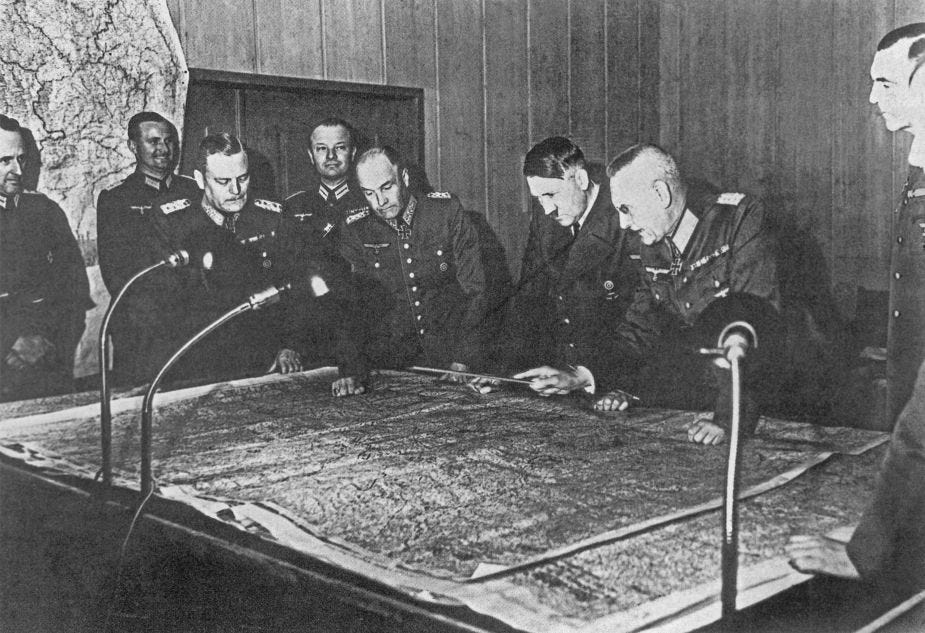
On 18 December 1940, Adolf Hitler issues Directive No. 21, outlining the German plan for an invasion of the Soviet Union: Operation Barbarossa; referring to the 12th century Holy Roman — TimeGhost - On 18 December 1940, Adolf Hitler issues Directive No. 21, outlining the German plan for an invasion of the Soviet Union: Operation Barbarossa; referring to the 12th century Holy Roman
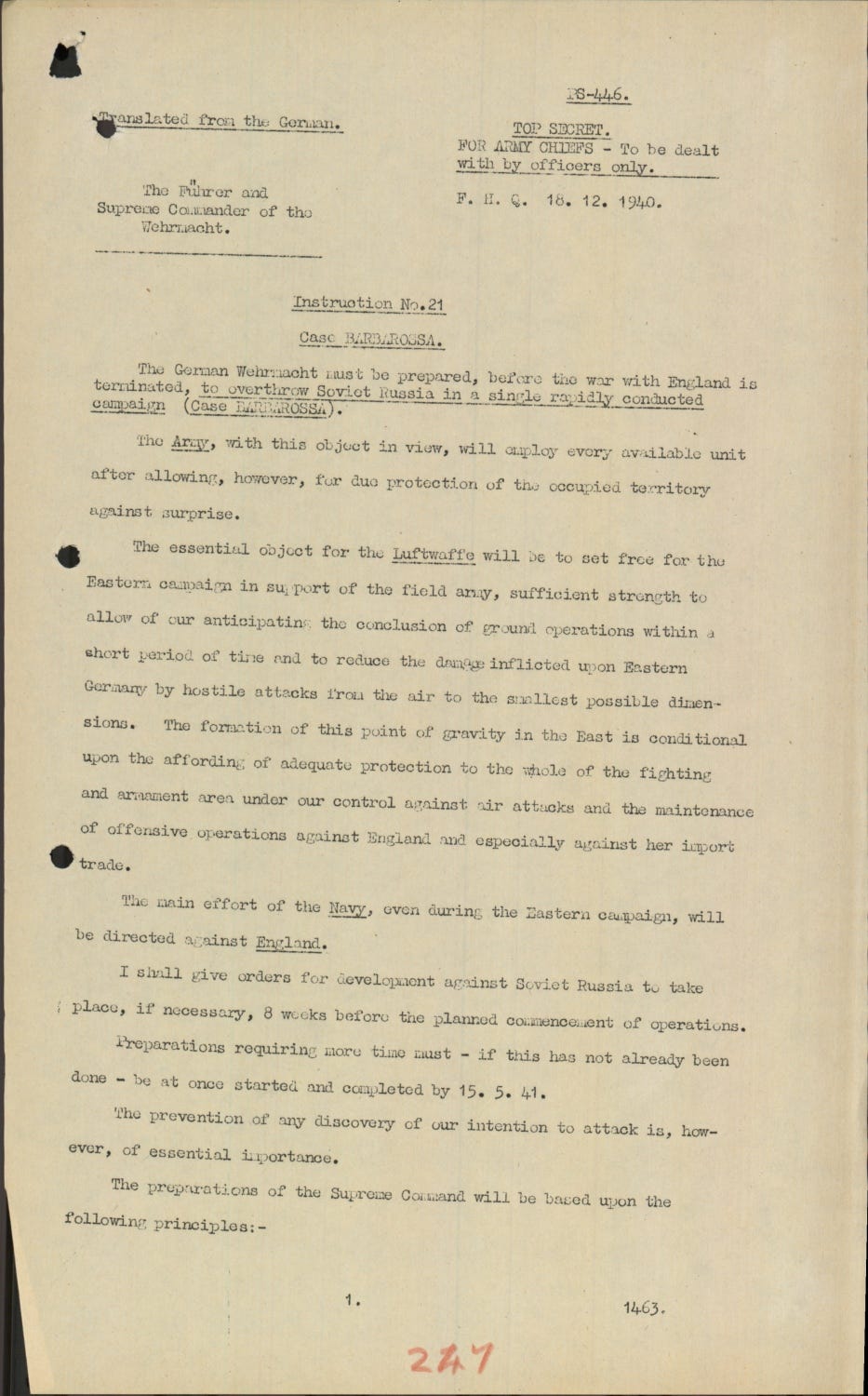
The directive itself is chilling in its bureaucratic precision. “The mass of the Russian army in western Russia is to be destroyed in bold operations involving deep penetrations of armored spearheads,” it reads. “The retreat of intact, combat-ready units into the vastness of Russian territory is to be prevented.” The language is clinical, the ambition breathtaking. But what the document does not say is as important as what it does.
Hitler’s signature did not just launch tanks. It activated a machinery of annihilation that had been planned in parallel for months—by the Wehrmacht, the SS, the Economic Staff East, and the Reich Ministry for the Occupied Eastern Territories. The directive’s military clauses were the visible tip of a submerged continent of genocide, starvation, and enslavement. The question that haunts historians is not why Hitler invaded—it is why his generals, his economists, his civil servants, and his industrialists all believed they could win, and what they were willing to do to try.
The answer lies in the pages of Directive No. 21—and in the months of secret meetings, memos, and murderous calculations that preceded it.
Nuremberg - Document Viewer - Directive 21, on preparations for the invasion of the Soviet Union in 1941, with Hitler’s strategy for the attack and instructions to the army, air force, and navy — Nuremberg - Document Viewer - Directive 21, on preparations for the invasion of the Soviet Union in 1941, with Hitler’s strategy for the attack and instructions to the army, air force, and navy

The Reconstruction
The Ideological Foundation
To understand Directive No. 21, one must first understand that it was not a military document disguised as a political one—it was the opposite. Hitler had always
