


The year is 1951. The page is glossy, the colors are saturated, and the man is leaning back in an armchair with the casual authority of someone who owns the air he breathes. His suit is impeccable, his tie—a Van Heusen, naturally—is knotted with geometric precision. He is not looking at the camera. He is looking at her.
She stands behind him, one hand resting on his shoulder, her posture a study in deferential grace. Her dress is modest, her hair is perfect, her smile is a contract. She is not looking at the camera either. She is looking at him. The caption, in bold sans-serif letters, delivers the thesis: “Show her it’s a man’s world.”
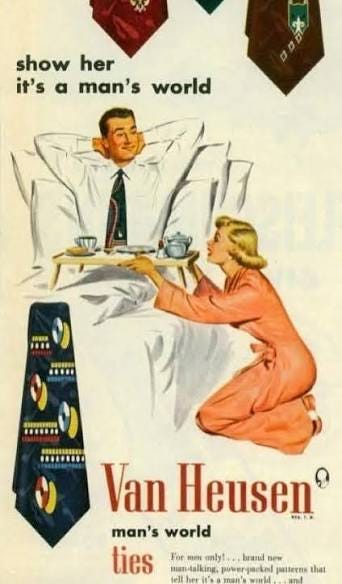
This is not a photograph. It is a blueprint. A manual for social architecture, printed on pulp paper and sold for thirty-five cents. The image is crisp, the lighting is flattering, and the message is surgical: a man’s world is not something you argue for—it is something you show. And the woman, by her presence, is the evidence.
But look closer. The man’s hand is not on her. It is on the armrest. The woman’s hand is on him, but her fingers do not grip; they hover, as if she is about to be photographed and must not touch the merchandise. The tie is the centerpiece—a striped, silken talisman of masculine order. The ad is not selling fabric. It is selling a cosmology.
What You Think You See
The romanticized reading of this ad is almost too easy. It is a relic, a period piece, a quaint artifact of mid-century patriarchy. We see it and nod knowingly: Ah, the 1950s. When men were men, women were wives, and advertising was honest about its misogyny. We file it under “nostalgia for a time that never existed” or “evidence of how far we’ve come.” The woman is a prop. The man is a king. The tie is a crown.
But this reading is a trap. It allows us to feel superior without understanding the machinery. The ad is not a reflection of some organic social order; it is a manufactured one. The “man’s world” it depicts was not a natural state—it was a recent invention, a frantic response to economic and political tremors that had shaken the very foundation of masculine authority.
The 1950s were not a stable plateau of gender roles. They were a fever dream of reconstruction. After the Second World War, millions of women who had worked in factories, run households alone, and managed wartime economies were told to return to the kitchen. The Rosie the Riveter icon was retired, and in her place came the suburban housewife. But this was not a restoration of tradition—it was a creation of a new tradition, one that required constant reinforcement through media, psychology, and consumer goods.
The Van Heusen ad is part of that reinforcement. It is not describing a world; it is prescribing one. The woman’s smile is not natural—it is contractual. She is the audience, not the subject. The ad is telling her: your role is to show him that he is the center. And the man, for all his apparent power, is equally trapped: he must perform dominance, must wear the tie, must lean back in the chair as if he has never doubted his place.
What Was Really Happening
To understand the Van Heusen ad, you must understand the crisis of masculinity that preceded it. The Great Depression had decimated male breadwinners. The war had sent men to die and women to work. When the soldiers returned, they came home to a world where their authority was no longer automatic. Women had proven they could run industries. Black soldiers had fought for a democracy that denied them citizenship. The entire architecture of white male supremacy was creaking under the weight of its own contradictions.
The response was a coordinated campaign—not from some shadowy cabal, but from a diffuse network of advertisers, psychologists, government officials, and corporate executives who understood that social order required constant maintenance. The 1950s “man’s world” was not a natural inheritance; it was a reboot.
The Van Heusen ad is a node in this network. It was created by the advertising agency Grey Advertising, which specialized in “masculine” products. The tagline “Show her it’s a man’s world” is not an observation—it is a command. It assumes that the man is insecure, that he needs to prove something, and that the woman is the audience for his performance. The ad is selling not just a tie, but a confidence that the buyer may not feel.
Who benefited? Van Heusen, obviously, sold ties. But the deeper beneficiary was the entire system of corporate consumerism that relied on stable, gendered roles. If men were breadwinners, they needed suits, ties, cars, razors, and life insurance. If women were homemakers, they needed appliances, cleaning products, and cosmetics. The ad reinforced the very structure that made consumer capitalism profitable.
And the woman in the ad? She is not a person; she is a mirror. Her function is to reflect the man’s importance back to him. The ad does not need her to have a personality, a job, or a desire. It needs her to be a witness. The man is not looking at her; he is looking at the idea of her. She is the proof of his success.
What’s Outside the Frame
The photograph is cropped tightly. We see the man, the woman, the chair, the tie. But what is outside the frame?
First, the woman’s life. She is not wearing a wedding ring in the ad—a telling detail. Perhaps she is a wife, perhaps a secretary, perhaps a fantasy. But the ad does not allow her to have a past or a future. She exists only in this moment of deferential touch. Outside the frame, she might have children, ambitions, or a bank account she cannot control. She might have worked in a factory during the war. She might have been a Rosie. But that narrative is cropped out.
Second, the economy. The ad was published in 1951, at the height of the Korean War. The American economy was booming, but it was a boom built on military spending and suburban expansion. The “man’s world” was underwritten by the GI Bill, which gave white men access to education and housing loans while systematically excluding Black veterans. The ad’s vision of masculine authority was racially coded: the man is white, the woman is white, and the world they inhabit is one of racial homogeneity. The frame excludes the violence that maintained that homogeneity—the redlining, the lynchings, the segregation that made the suburban idyll possible.
Third, the man’s anxiety. The ad tells him to “show her it’s a man’s world,” but that instruction implies that he might fail. The ad is a lifeline to a man drowning in doubt. Outside the frame is the fear of inadequacy, the pressure to provide, the terror of being seen as weak. The man’s confident lean is a performance. The ad is his script.
The System
The Van Heusen ad is not an outlier; it is a symptom of a larger system—what the sociologist C. Wright Mills called the “power elite.” In the post-war period, a small group of corporate, military, and political leaders coordinated to shape American life. Advertising was the propaganda arm of this coordination.
The system worked through three mechanisms:
1. The creation of desire. Advertising did not simply reflect existing desires; it manufactured them. The Van Heusen ad does not sell a tie; it sells a feeling of mastery. The man who buys the tie is buying the illusion that he can control his world. The woman who sees the ad is being trained to recognize that mastery as attractive.
2. The pathologization of deviation. The 1950s saw the rise of “experts” who defined normalcy. Psychologists like Benjamin Spock told mothers how to raise children. Sociologists like Talcott Parsons defined the “functional” nuclear family. Advertisers like those at Grey Advertising translated these norms into visual language. The ad is not just selling a product; it is policing a boundary. If you do not show her it’s a man’s world, you are failing at masculinity.
3. The privatization of responsibility. The ad places the burden of proof on the individual man. He must perform dominance, must buy the tie, must lean back in the chair. The system that created his insecurity—the economic pressures, the racial hierarchies, the corporate control of labor—is invisible. The ad tells him that his problems are personal, not structural. The solution is a purchase.
This system was not unique to the 1950s. It is the same system that, today, sells self-improvement as a substitute for collective action, that turns political anger into consumer identity, that tells us we can buy our way out of anxiety. The Van Heusen ad is a fossil, but the strata it belongs to are still being laid down.
Why It Still Matters
The Van Heusen ad is not a relic. It is a template.
Look at any modern advertisement for men’s products—watches, cologne, cars, whiskey—and you will see the same structure. The man is confident, leaning back, looking at something off-camera. The woman is present but secondary, her role to validate his success. The caption may have changed—“Be your own man,” “Define your legacy,” “Own the moment”—but the grammar is identical. The ad still tells men to perform dominance and women to perform deference. It just uses different words.
The difference is that we no longer recognize the performance as performance. We have internalized the script. The 1950s ad is easy to mock because it is explicit. The modern ad is harder to see because it is implied. The same system—the manufacturing of desire, the pathologization of deviation, the privatization of responsibility—is still operating. The product has changed; the message has not.
And the woman outside the frame? She is still there. She is the one who is told to smile, to be supportive, to make the man feel like a man. She is the one whose labor—emotional, domestic, reproductive—is invisible. She is the one who is cropped out of the narrative, even when she is in the picture.
The Van Heusen ad matters because it shows us the blueprint. Once you see it, you cannot unsee it. You start to notice the same pattern in political campaigns, in corporate culture, in the way we talk about leadership and success. The ad is a window into a system that is still building the house we live in.
The Exit
The man in the Van Heusen ad is not powerful. He is an actor in a play he did not write, performing a role he did not choose. The woman is not passive. She is the audience, the mirror, the proof. And the tie is not a tie. It is a leash.
The photograph lies, but not in the way you think. It does not lie about the past; it lies about the present. It tells us that the world it depicts is natural, inevitable, eternal. But it is none of those things. It is a construction, a fragile one, propped up by billions of dollars of advertising and centuries of violence.
The question the ad leaves us with is not “How did we get here?” but “What are we still showing?” When you look at the images around you—the ads, the news, the social media feeds—ask yourself: who is in the frame, and who is outside it? Who is leaning back, and who is standing behind? And what are we being sold, disguised as a truth?
The full reconstruction of this event—including the primary sources institutions left out—is available to paid subscribers below.