Why did a government that had the body, the fingerprints and the photographs still fail, for thirty years, to close the story of Che Guevara’s death?
The thirty years between 1967 and 1997 are usually told as a detective story: a secret burial, a general who finally talked, a search team with shovels and dental records. That version is accurate as far as it goes. It is also incomplete, because it treats the missing grave as a puzzle about bones, when what was actually missing for three decades was a fixed, physical place where the death could be checked against the world. Monday’s reading of the laundry photograph and Wednesday’s Case File on the kill order both deal with 1967. This is about what came after.
Why did hiding the body work as a tactic and fail as a strategy?
A body with no address
After the display in the hospital laundry, Guevara’s body was flown out of public view and buried in secret under the Vallegrande airstrip. Bolivia’s own account of what had happened to it changed within days of the burial; Wednesday’s Case File follows that contradiction in detail. What matters here is the consequence: there was no grave to visit, no marker to photograph, nothing a journalist, a biographer or a government could point to and say, settled. For twenty-eight years, the only fixed, publishable evidence that Che Guevara had died in Bolivia was Freddy Alborta’s photograph and the handful of others taken in that laundry on 10 October 1967. The image did not just record the death. In the absence of a grave, it became the record.
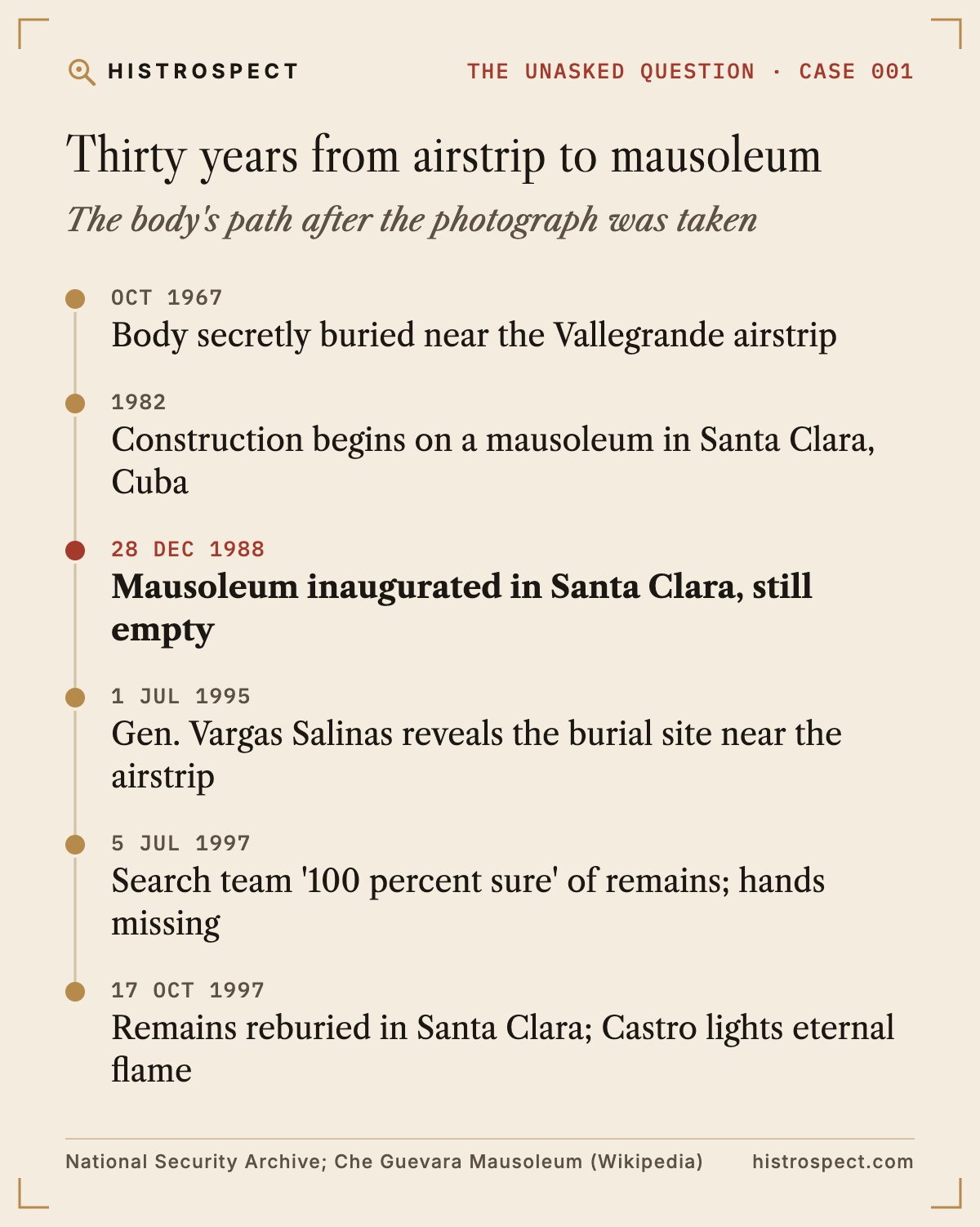
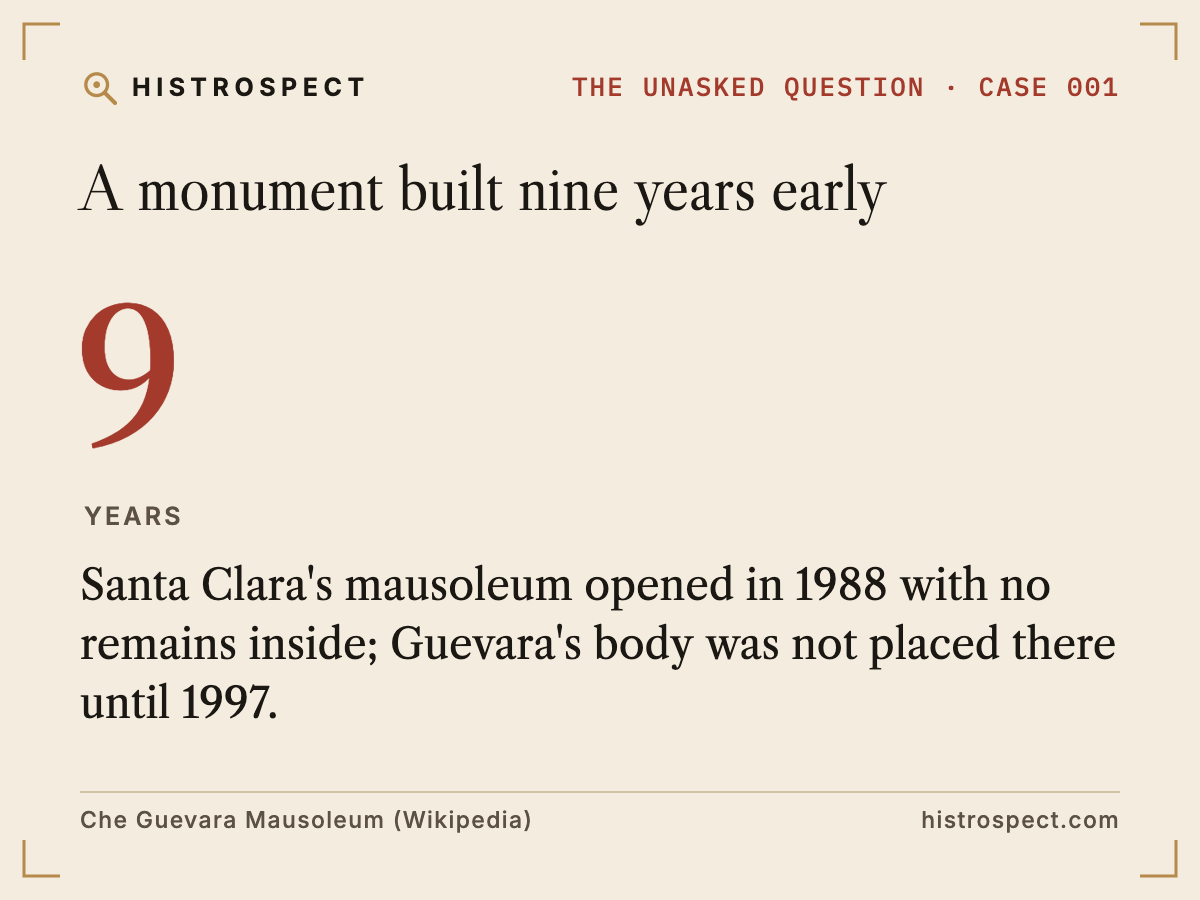
Cuba did not wait for the body to build its monument. Construction on a mausoleum in Santa Clara began in 1982, and the structure was inaugurated on 28 December 1988 — nine years before there were any remains inside it. For almost a decade, Cuba maintained a sealed shrine to a man whose physical remains were, officially, still unaccounted for. The monument and the photograph were doing the same work in different registers: both stood in for a grave that did not exist.
What finally closed it, and what didn’t
The silence broke from inside the Bolivian military, not from any photograph. On 1 July 1995, retired General Mario Vargas Salinas said publicly that the body had been buried in a mass grave near the Vallegrande airstrip — the first time anyone with direct knowledge had put a location on the record. Excavation took two more years. On 5 July 1997, a forensic team announced it was ‘100 percent sure’ it had found Guevara’s remains; the decisive evidence was a skeleton with both hands missing, matching the amputation carried out for identification in 1967. The remains were flown to Cuba on 13 July and buried in Santa Clara on 17 October 1997, at first alongside six other guerrillas who had died with him in Bolivia, under an eternal flame that Fidel Castro lit himself.
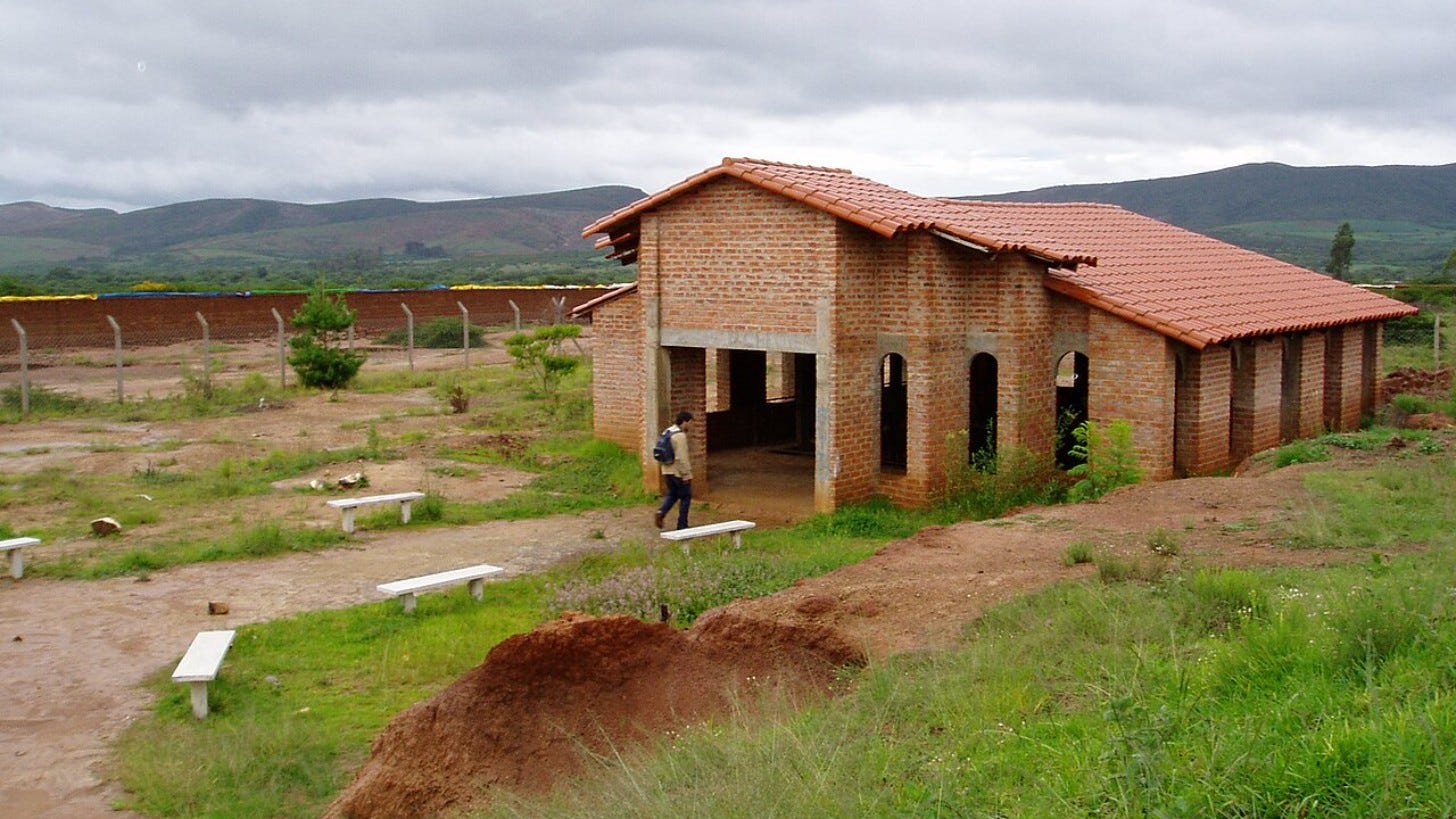
It is worth noting what the discovery did not do. It did not retire the photograph. Vallegrande’s hospital laundry is now a pilgrimage site in its own right, and a second mausoleum stands in the town on the former burial ground, alongside the one in Santa Clara that holds the actual remains. The town built a monument to the place the body had been hidden; Cuba kept the monument to the place it finally arrived. Two shrines, for one body, in two countries — because for thirty years the only place anyone could reliably find Che Guevara dead was in a photograph.
What would change our reading: if it turned out Bolivian officials had kept the airstrip grave deliberately marked or recorded for internal use, rather than genuinely lost to all but a handful of officers, the thirty-year gap would look less like an accident of secrecy and more like calculated theatre, and the claim here would need revising. The evidence so far — a location that took a retired general’s confession and two more years of digging to recover — points the other way. The hiding worked. It just didn’t work on the photograph.
The order that sent Che Guevara to that laundry is a separate, documented story, built from a CIA officer’s own debriefing and Bolivia’s contradictory public statements in the days after. Wednesday’s Case File follows it link by link.