


By the mid-1960s, roughly 250,000 white Rhodesians governed a country of 5 million Black Africans. They were outnumbered twenty to one. The international community had declared their Unilateral Declaration of Independence illegal in 1965. Sanctions choked the economy. And from 1964 onward, two armed nationalist movements—ZANU and ZAPU—waged a guerrilla war to overthrow white rule. The Bush War was not a conventional conflict. It was a slow, grinding insurgency fought in the scrublands of the Zambezi Valley, along the Mozambican border, and in the dense suburbs of Salisbury.
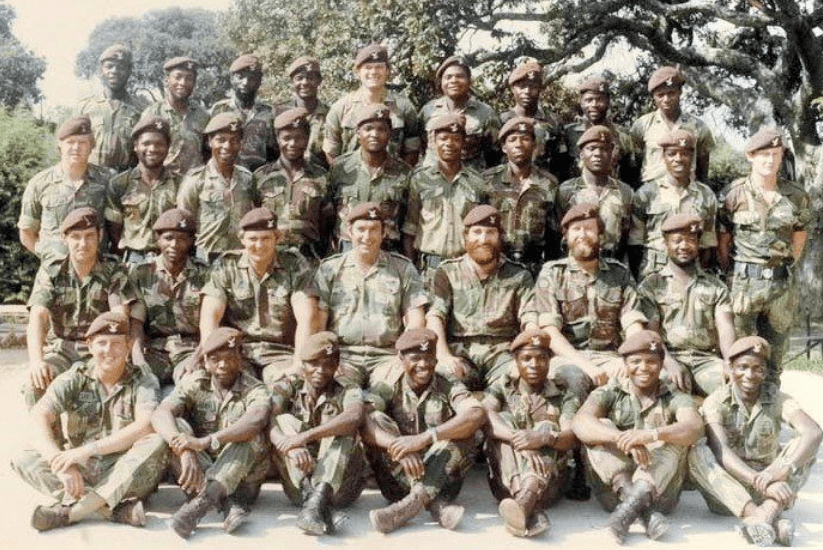
The white Rhodesians had no reinforcements coming. Britain would not intervene. The UN condemned them. South Africa, their only ally, grew increasingly unreliable as the war dragged on. They were a demographic island, surrounded by hostile states and a restive population. Their survival depended not on overwhelming force—they never had that—but on a set of improvised, often ruthless tactics designed to extend the life of a system that was, in the long run, unsustainable.
They knew they were fighting for time, not victory. And that is the first lesson.
Why They’re Your Teachers
You are not a white Rhodesian. You are not fighting a guerrilla war. But you may be a minority in a system that is turning against you—a political dissenter in an increasingly polarized country, a professional whose industry is being dismantled by regulation, a member of a cultural or religious group that is being systematically marginalized. The pressure is not gunfire; it is economic strangulation, social ostracism, and legal harassment. The Bush War offers a manual for how a small, committed group can hold its ground against overwhelming odds when the world has decided you are the enemy. These tactics are not for winning—they are for enduring long enough to find a new path.
The Principles
1. Centralize decision-making, decentralize execution.
The Rhodesian Security Forces were tiny—never more than 20,000 regulars at their peak. But they operated with extraordinary efficiency because command was unified under a single military hierarchy, while tactical decisions were pushed down to the lowest level. A junior officer in the bush could call in air support or authorize a strike without waiting for Salisbury. This speed allowed them to hit guerrilla bases before the enemy could react.
Your move: In your organization or movement, eliminate bureaucratic bottlenecks. Give the people on the ground authority to act within clear boundaries. In a siege, speed is oxygen. Committees are death.
2. Turn your weakness into a weapon.
White Rhodesians were outnumbered, but they were also hyper-mobile. They used light aircraft, helicopters, and small patrols to cover vast distances. They didn’t try to hold territory—they hunted. The Fireforce tactic, where a rapid reaction team would be dropped on a contact within minutes, turned their numerical disadvantage into a tactical advantage. They could not be everywhere, but they could appear anywhere, instantly.
Your move: Don’t try to match your opponent’s scale. Identify what you can do faster, more discreetly, or more precisely than the larger force. If you’re outgunned, be nimble. If you’re outnumbered, be invisible. If you’re outspent, be creative.
3. Build a parallel system of supply and loyalty.
International sanctions meant Rhodesia could not buy arms, fuel, or spare parts. So they built their own—a domestic arms industry, a secret oil supply chain through South Africa, and a network of sympathetic businesses that operated in the gray market. They also cultivated loyalty through a system of conscription that made every white man a soldier and every white woman a support worker. The entire community was mobilized because the entire community was at risk.
Your move: If the mainstream system is hostile, build your own. Create alternative supply chains, independent funding sources, and mutual aid networks. This is not about secession—it’s about resilience. When the grid goes down, your grid must still run.
4. Use psychological operations on your own side.
The Rhodesian government understood that morale was a battlefield. They controlled the media tightly, presented the war as a defense of civilization against communism, and celebrated every small victory. They also used propaganda to demoralize the enemy—broadcasting messages, dropping leaflets, and turning captured guerrillas into informants. They fought for the narrative as hard as they fought for the ground.
Your move: In any prolonged struggle, the internal story you tell matters more than external facts. Create rituals, symbols, and shared language that reinforce your purpose. Fight despair with narrative. If you don’t control the story of your own struggle, someone else will.
5. Know when to negotiate—and when to walk away.
By 1979, the Rhodesians were exhausted. The war had killed nearly 20,000 people, mostly Black civilians. The economy was collapsing. Even their own allies were pushing for a settlement. So they negotiated—not from weakness, but from a position of temporary strength. They got a constitution that protected white civil servants and property for a decade. Then they surrendered power. They did not win. But they did not lose everything.
Your move: The goal is not to fight forever. It is to survive until a better option appears. Know your exit conditions. When the cost of resistance exceeds the value of what you’re protecting, negotiate. A partial loss is better than total annihilation.

The Limit
The analogy breaks down in two critical ways. First, white Rhodesians were defending an unjust system—racial minority rule. Their tactics were often brutal, including forced relocations, collective punishment, and the use of child soldiers. You cannot separate the tactical brilliance from the moral failure. Second, they lost. The system fell in 1980. The lessons here are about survival, not victory. If you are fighting for a just cause, these tactics may help you endure. But if you are fighting to preserve an injustice, history suggests you will eventually be overwhelmed—and you should be. The Bush War is a manual for the desperate, not the righteous. Use it with caution.