


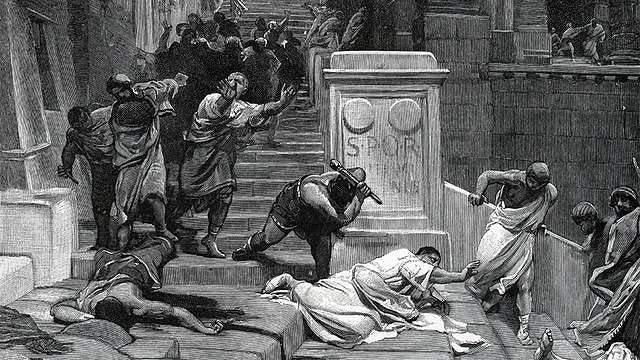
In 133 BC, a tribune named Tiberius Gracchus proposed land reform to help Rome’s dispossessed farmers. It was not radical by any modern measure. It was radical only in this sense: he bypassed the Senate’s customary deliberation and took the bill straight to the popular assembly. For that procedural shortcut, a mob of senators clubbed him to death in the street with broken furniture. His brother Gaius, twelve years later, met a similar end. From that point on, for roughly a century, the unwritten rules that had held Roman politics together — the mos maiorum, the “way of the ancestors,” never codified but universally understood — began dissolving one precedent at a time. Marius held five consecutive consulships in defiance of custom. Sulla marched his own legions on Rome, something no Roman had done before. Political murder became a normal tool of policy. Citizens watched the offices, courts, and assemblies they’d trusted their whole lives turn into weapons in a decades-long elite power struggle, until the whole apparatus finally handed itself to one man, Augustus, in exchange for stability.
Why They’re Your Teachers
The late Republic is the best-documented case in Western history of a functioning constitutional order dying not from a single coup but from the slow, incremental normalization of “the rules don’t apply this time.” Nobody in 133 BC believed they were witnessing the death of a republic — they believed they were witnessing a series of unfortunate but explainable exceptions. That is precisely the danger of norm collapse now: it never announces itself as collapse. It arrives dressed as expedience, precedent by precedent, and the Romans left behind a century-long record of exactly how ordinary and elite behavior adapted, resisted, or capitulated at each stage.
The Principles
1. Name the violation the moment it happens. When Tiberius Gracchus bypassed senatorial approval, his opponents didn’t just disagree — they insisted, loudly and immediately, that a line had been crossed, even before they resorted to violence. The mistake later generations made was letting subsequent violations pass without that same clear naming, so each one landed as slightly less shocking than the last. The first broken norm is always the cheapest one to call out and the most expensive one to ignore. Modern translation: when an institution bends a rule “just this once,” say so explicitly and on the record, before it becomes the new baseline — silence is what makes precedent two.
2. Don’t let emergency powers outlive the emergency. Sulla’s dictatorship was legally a temporary, defined office meant for crises — he simply refused to give it back on schedule, and the precedent that “temporary” power could become permanent stuck. Cincinnatus, centuries earlier, was the model everyone claimed to admire and nobody imitated: appointed dictator, he finished the crisis and resigned in sixteen days. Modern translation: track every “emergency” authority granted to any office by its sunset date, and treat any refusal to relinquish it on time as the actual crisis, not a footnote to the original one.
3. Keep your institutional loyalty higher than your factional loyalty. Cicero spent his career trying, imperfectly, to hold the Senate’s legitimacy above whichever faction currently flattered him, and it cost him allies on every side — but it’s also why his writings became the definitional record of what the Republic was supposed to be. Marius and Sulla, by contrast, treated the army as loyal to them personally rather than to Rome, and that reallocation of loyalty is the specific mechanism that made civil war possible. Modern translation: whatever institution you serve — a court, a newsroom, a agency, a company — ask whether your loyalty runs to the role or to the person currently occupying it, because that’s the exact seam autocrats learn to exploit.
4. Preserve the boring paperwork of legitimacy. Roman censuses, land records, and the acta diurna (the daily public record of Senate proceedings and events) kept surviving even as violence escalated, and it’s largely why historians — and Romans themselves — could still tell truth from propaganda for decades afterward. Authoritarian drift depends on nobody being able to prove what the rule used to be. Modern translation: keep your own plain records — dates, memos, vote counts, who said what — because institutional memory is the first casualty of chaos and the last thing a bad-faith actor wants available.
5. Refuse the shortcut even when it would help your side. Cato the Younger opposed Caesar relentlessly, but he also opposed corrupt tactics from his own allies when they tried them, famously walking out of a rigged election process rather than legitimize it by participating. His stubbornness looked politically foolish in the moment and looks, in hindsight, like the last real defense the Republic had. Modern translation: the test of whether you actually value a norm is whether you’ll defend it when breaking it would benefit your own side — anything else is just tribalism wearing the language of principle.
6. Don’t mistake stability for restoration. When Augustus finally ended the chaos in 27 BC, most Romans were relieved — bread was affordable, the murders stopped, the calendar worked again. What they traded for that relief was the Republic itself, permanently, dressed up in republican vocabulary that fooled almost nobody who looked closely, and satisfied almost everyone too tired to look. Modern translation: be suspicious of “finally, normal again” moments that arrive through the concentration of power rather than the repair of process — calm is not the same thing as constitutional health.

The Limit
The honest caveat: Rome had no printing press, no broadcast media, no internet — its “norm erosion” played out over generations, at a pace that allowed contemporaries decades to misjudge the trajectory precisely because it was slow. Modern institutional collapse, when it happens, can compress that same arc into a handful of years or even months, powered by information systems that spread both the violations and the normalization of them at a speed no Roman senator could have imagined. The mechanism is recognizable across two thousand years; the clock speed is not, and that difference is the whole ballgame. The Republic also had no real alternative model of governance to fall back on — modern societies at least have historical memory of democratic recovery to draw from, which the Romans, inventing constitutional government as they went, simply did not.