


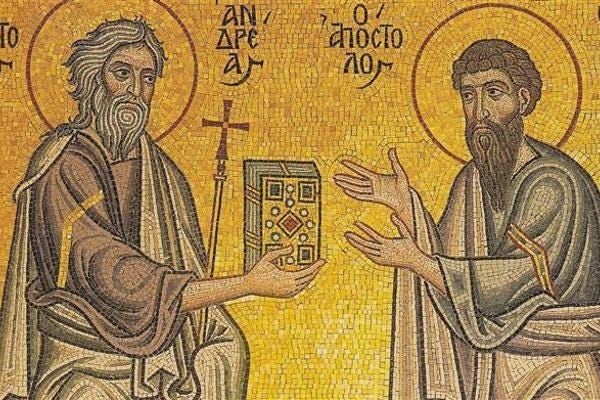
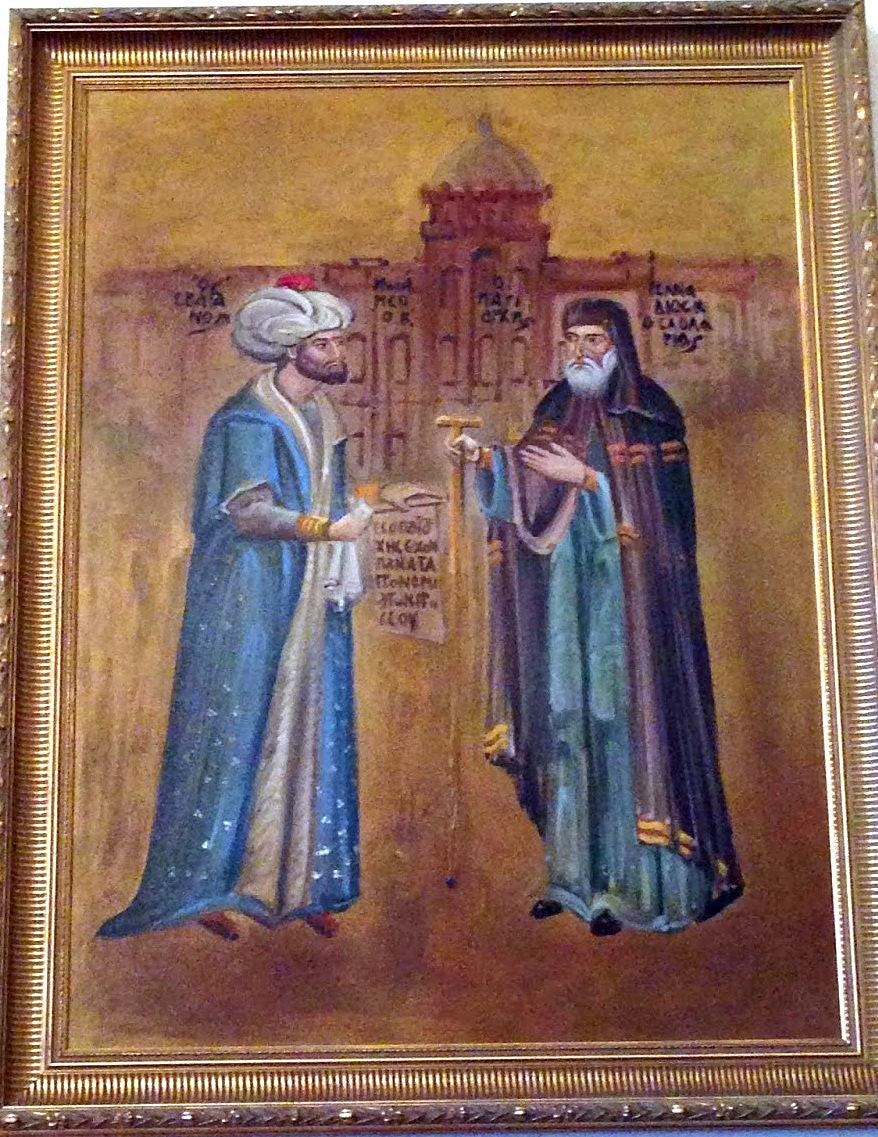
In the spring of 1453, when Constantinople fell to the Ottoman armies of Mehmed II, the Greek Orthodox world did not end. It went underground.
For nearly four centuries afterward, from 1453 to the outbreak of the Greek War of Independence in 1821, the Greek Orthodox people lived as a millet — a legally defined religious community under Islamic rule. They were second-class citizens, taxed heavier, barred from bearing arms, forbidden from building new churches, and subject to periodic violence, forced conversions, and the abduction of their children into the Janissary corps. Their patriarch was appointed by the Sultan. Their faith was tolerated, but only just.
And yet, when the revolution finally came, the Greek Orthodox had not merely survived. They had preserved a language, a liturgy, a calendar, a set of rituals, and a sense of peoplehood that would become the foundation of a modern nation.
The question is how. How do you keep a culture alive when every structural pressure — legal, economic, military — is designed to dissolve it? The answer lies not in grand resistance, but in a quiet, stubborn architecture of identity-maintenance that the Greek Orthodox perfected over generations. Their methods were not heroic in the epic sense. They were domestic, liturgical, pedagogical, and communal. And they worked.
Why They’re Your Teachers
You are not living under Ottoman rule. But you are living under a regime of attention — a digital, commercial, and political ecosystem that constantly pulls you toward distraction, fragmentation, and the erosion of your inner life. Your identity is under siege not by a Sultan, but by algorithms, news cycles, and a culture that rewards reactivity over reflection. The Greek Orthodox survived 400 years of external pressure by building internal structures that could not be conquered. You need the same.
The Principles
1. The Liturgical Calendar Is Your Shield
The Greek Orthodox did not preserve their identity through sporadic acts of defiance. They preserved it through rhythm. The liturgical calendar — with its fixed feasts, fasts, saints’ days, and cycles of readings — structured time itself. Every week had a pattern. Every season had a purpose. The peasant in a remote village knew that today was the feast of Saint Demetrios, and that meant a specific prayer, a specific meal, a specific break from labor.
The translation: Your attention is under constant assault from the calendar of the algorithm — a calendar that has no Sabbath, no feast, no fast, no pause. Build your own liturgical calendar. It doesn’t have to be religious. It could be a weekly reading night, a monthly dinner with friends, a quarterly retreat from screens. The point is not the content. The point is the rhythm. The rhythm becomes the container that holds your identity when everything else tries to pull you apart.
2. The Household Is the First Church
Under Ottoman rule, the church building was often a risk. New construction was forbidden; old churches could be converted into mosques. So the Greek Orthodox moved the center of their faith into the home. Icons were hung in the corner of the main room. The father led evening prayers. Children learned the alphabet from the Psalms, not from a schoolbook. The household became a sanctuary — not metaphorically, but literally.
The translation: You cannot rely on institutions — schools, media, government — to preserve your values or your sense of self. They are too compromised, too slow, too distracted. You must make your home the primary site of your identity formation. This means curating what enters your home: the books on your shelf, the conversations at dinner, the media you consume together. If you don’t consciously shape the culture of your household, the algorithm will shape it for you.
3. The Secret School Is Your Real Education
The Ottomans allowed limited education for Christians, but it was supervised and often shallow. The real learning happened in kryfó scholío — the “secret school” — held in basements, in monasteries, in the back rooms of churches. There, children were taught Greek literacy, Orthodox theology, Byzantine history, and the lives of the saints. This was not nostalgia. It was survival. Without this hidden curriculum, the next generation would have no language to think with, no story to belong to.
The translation: The mainstream education system — whether K-12 or university — is not designed to preserve your deepest values. It is designed to produce productive workers and compliant citizens. If you want to pass on what actually matters, you need a parallel curriculum. This could be a regular book club with your children, a podcast you listen to together, a skill you teach them that has no market value but deep personal meaning. The “secret school” is whatever you do that the system does not know about and does not reward.
4. The Icon Is Not Decoration; It Is a Window
In Orthodox theology, an icon is not a painting. It is a “window into heaven” — a material object that connects the viewer to a spiritual reality. Under Ottoman rule, icons became even more important. They were portable. They could be hidden. They could be kissed, wept over, carried into exile. The icon was a technology of presence — a way of keeping the divine near when the world was hostile.
The translation: You need physical objects that anchor your identity. Not digital files. Not cloud storage. Physical objects. A book your grandfather gave you. A photograph of a place that shaped you. A piece of art that reminds you of who you are when the world tries to tell you who to be. In an age of digital abstraction, the physical is a form of resistance. Touch matters. Presence matters. The icon in your pocket is not a phone; it is a stone.
5. The Community Is the Archive
When the Ottomans burned manuscripts or closed monasteries, the knowledge did not disappear — because it was stored in the bodies and memories of the people. The old woman who knew the hymns by heart. The priest who could chant the entire liturgy from memory. The village that knew the date of every saint’s feast because it was woven into the fabric of their shared life. The community itself was the library.
The translation: You cannot preserve your identity alone. You need a small, intentional community — a millet of your own — that holds the same stories, the same practices, the same commitments. This is not a Facebook group. It is a group of people who meet in person, who share meals, who argue and pray and work together. When the larger culture forgets, the small community remembers. And that memory is your survival.
6. The Fast Is a Form of Freedom
The Orthodox tradition of fasting — abstaining from meat, dairy, and wine on Wednesdays, Fridays, and during Lent — was not merely a religious obligation. It was a practice of discipline that created a counter-rhythm to the dominant culture. To fast was to say: “I am not ruled by appetite. I am not ruled by the harvest. I am ruled by something else.” It was a small, daily act of sovereignty.
The translation: You need practices of voluntary deprivation — not because deprivation is good in itself, but because it trains the will. Give up your phone for one day a week. Fast from news for a month. Choose a simpler meal than you could afford. The point is not the sacrifice; the point is the muscle you build by making a choice that the culture does not require. That muscle is what you will need when the culture demands something you cannot give.
7. The Martyr’s Memory Is the Community’s Fuel
The Greek Orthodox calendar is filled with martyrs — men and women who died rather than renounce their faith. Under Ottoman rule, these stories were not morbid history. They were fuel. When a village was threatened with forced conversion, the priest would tell the story of Saint George or Saint Catherine. The message was clear: others have faced this choice and chosen death. You can face this too.
The translation: You need stories of people who endured what you are afraid of enduring. Not to scare you, but to prepare you. Read biographies of people who resisted totalitarian regimes. Read accounts of those who maintained their integrity in corrupt institutions. The memory of their courage is a resource you can draw on when your own courage falters. You do not need to be a hero. You just need to remember that heroes existed.

This analogy has a limit. The Ottoman Empire was a pre-modern state with limited reach. It could not track your thoughts, monitor your screen time, or algorithmically optimize your attention for maximum extraction. The pressure on the Greek Orthodox was external, visible, and often brutal — but it was also slow. You had time to adapt, to build your secret schools and your household sanctuaries. The modern siege is faster, softer, and more intimate. It reaches into your pocket, your bedroom, your mind, in moments of weakness and boredom alike. The Greek Orthodox had walls to build. You have no walls at all. That does not make their lessons irrelevant. It makes them more urgent. But it also means you must adapt their strategies to a war fought not with swords and sultans, but with notifications and narratives. The enemy is not a foreign empire. The enemy is the erosion of your ability to choose what you attend to. And that enemy is inside the gates.