


On the morning of June 28, 1389, a Serbian prince named Lazar Hrebeljanović knelt on a field of wheat stubble in the Kosovo plain. He was a tall man in his early sixties, with a graying beard and the weathered hands of a ruler who had spent decades consolidating a fragile coalition of Balkan lords. His armor, polished to a dull gleam, bore the cross of the Serbian Orthodox Church. Around him, perhaps 15,000 men—Serbs, Bosnians, Albanians, and Wallachians—stood in formation under a sky that promised heat.
Across the field, less than a mile away, the Ottoman Sultan Murad I sat on his campaign throne, surrounded by his janissaries and sipahi cavalry. Murad was seventy-three, a veteran of forty years of conquest. He had already swallowed half of the Balkans, turning Bulgarian tsars and Byzantine emperors into vassals. Today, he intended to finish Serbia.
“The earth is a witness to our deeds; the sky is a witness to our intentions. Let the blood of the martyrs be the ink with which we write the history of our faith.” — Attributed to Prince Lazar, speech before the Battle of Kosovo, June 1389 (recorded in later Serbian epic tradition)
Neither man knew that by nightfall, both would be dead. Nor could they have imagined that the battle they were about to fight would be remembered not as a tactical engagement but as a cosmic collision between Christendom and Islam—a myth that would shape the identity of nations for six centuries.
What actually happened on that field, and what was later invented, is the story of how a single afternoon of slaughter created the mental map that still divides East from West.
THE RECONSTRUCTION
The Battle of Kosovo took place at a moment when two worlds were collapsing into each other. The medieval Serbian Empire, once the dominant power in the Balkans under Tsar Stefan Dušan, had fragmented after his death in 1355. By 1389, Lazar controlled only a rump state centered on the Morava River valley. The Ottoman Empire, by contrast, was ascending. Murad I had already taken Adrianople (Edirne) in 1362, severed Constantinople from its Balkan hinterland, and crushed the Serbian army at the Battle of Maritsa in 1371.
The central tension of the battle was not simply military. It was existential. Lazar faced an impossible choice: submit to Murad and preserve his people as vassals, or resist and risk annihilation. The Serbian Church, which had long seen itself as the last bastion of Orthodox Christianity after the fall of the Byzantine heartland, pushed for resistance. The nobility, many of whom had already made private peace with the Ottomans, urged caution.
Lazar chose defiance. His coalition included Vuk Branković, a powerful Serbian lord with his own ambitions, and the Bosnian king Tvrtko I, who sent a contingent under the command of Vlatko Vuković. The army was a feudal patchwork—knights in heavy mail, infantry with spears and bows, and a core of professional soldiers.
Murad’s army was more unified. It included the janissary corps (Christian boys converted to Islam and trained as elite infantry), sipahi cavalry (land-grant warriors), and vassal contingents from Bulgaria and Byzantium. The Ottomans also had something the Serbs lacked: a coherent command structure and a tradition of tactical flexibility.
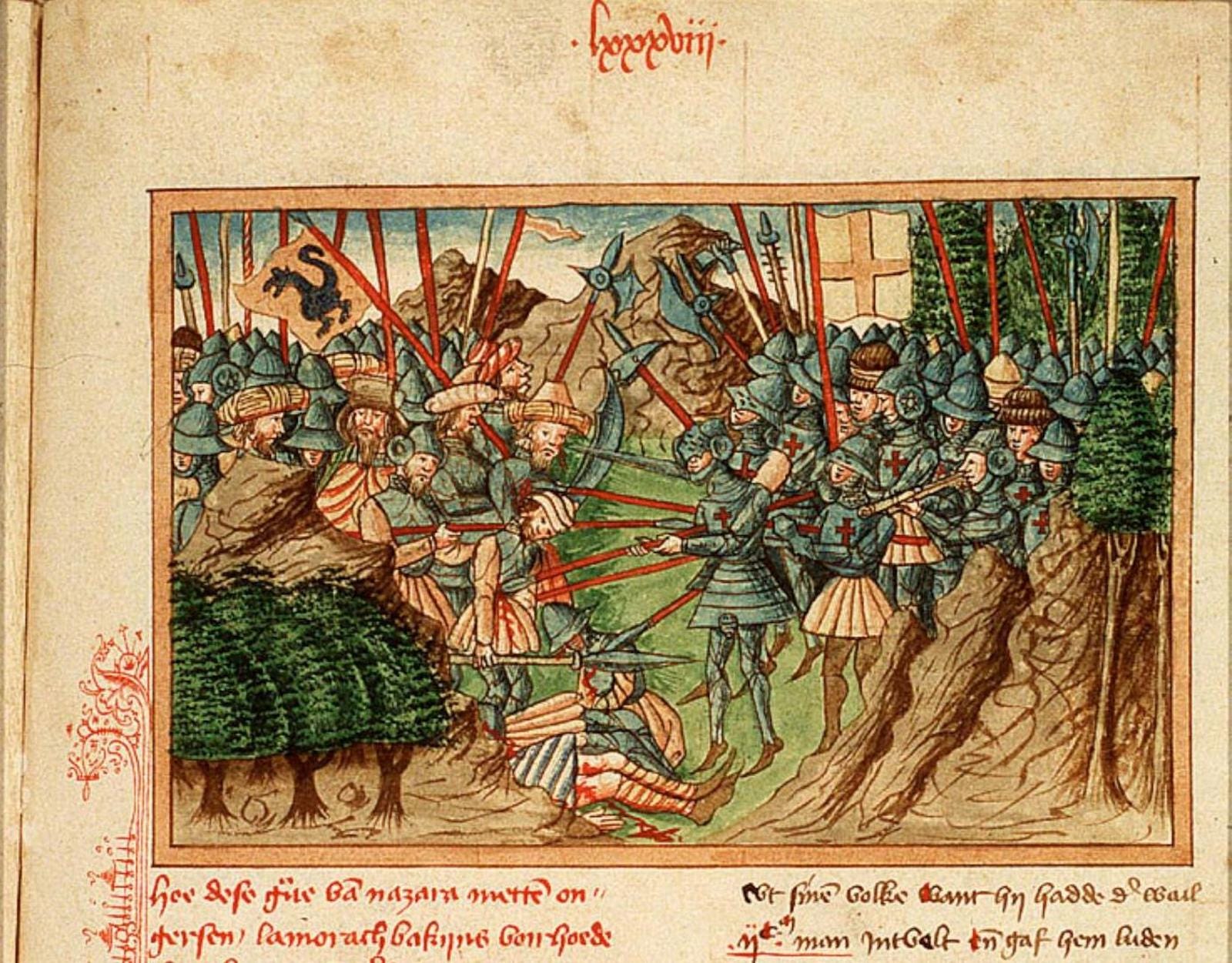
The battle began with a charge. The Serbian heavy cavalry, the finest in the Balkans, smashed into the Ottoman left wing, commanded by Murad’s son Bayezid. For a moment, it seemed the Serbs might break through. But Bayezid held, and the Ottoman center and right held firm. The fighting was close and brutal—hand-to-hand combat with swords, axes, and maces in the June heat.
Then came the event that would become legend. A Serbian knight named Miloš Obilić—if he existed—infiltrated the Ottoman camp by pretending to desert. He was brought before Sultan Murad, where he drew a hidden dagger and stabbed the old sultan to death. Murad’s son Bayezid immediately assumed command, ordering the execution of all prisoners and the concealment of his father’s death until the battle was won.
The Serbs, leaderless and exhausted, broke. Lazar was captured and beheaded on the field. The coalition dissolved. By nightfall, the Ottomans held the plain.
But the battle was not a decisive Ottoman victory in the conventional sense. Both armies were shattered. Bayezid had to withdraw to consolidate his power and deal with a succession crisis. Serbia survived as a vassal state for another seventy years. The battle did not open the gates of Europe to the Ottomans—those gates were already open.
Yet the battle’s meaning far exceeded its military outcome. Within a generation, Serbian monks and epic poets had transformed the defeat into a sacred catastrophe: the “Heavenly Serbia” narrative. Lazar, they said, had been given a choice by an angel: an earthly kingdom (victory and survival) or a heavenly kingdom (martyrdom and eternal glory). He chose the latter. The battle became a covenant—a blood pact between the Serbian people and God.
This is the myth that created the modern divide. The Battle of Kosovo was retrofitted as the moment when Christian Europe was betrayed by its own divisions and overwhelmed by an alien, Islamic East. It became the template for every subsequent clash: the siege of Vienna, the Greek War of Independence, the Bosnian War of the 1990s. The line drawn in the blood of Kosovo in 1389 is the line that still runs through the Balkans—and through the Western imagination.

THE LAYERS
Political: The Invention of the Enemy
The political afterlife of Kosovo 1389 is a case study in how a battle becomes a border. In the immediate aftermath, both sides treated the engagement as a draw. Serbian nobles negotiated favorable terms with Bayezid; the Orthodox Church was allowed to continue its work. But as the Ottoman Empire pressed deeper into Europe over the next century—taking Constantinople in 1453, besieging Vienna in 1529—the memory of Kosovo was weaponized.
