


On the morning of February 11, 1979, Tehran smelled of cordite and jasmine. For two days, the city had been a battlefield. The Imperial Iranian Air Force’s Homafaran barracks, a bastion of the Shah’s power, had fallen to a coalition of leftist guerrillas, religious militias, and defecting military officers. In the streets, women in chadors and men in Western suits tore down statues of the Pahlavi dynasty, smashing the bronze faces of Reza Shah and his son, Mohammad Reza. The Shah himself had fled on January 16, ostensibly for a “vacation” in Egypt, leaving behind a regency council that was already dissolving into chaos.
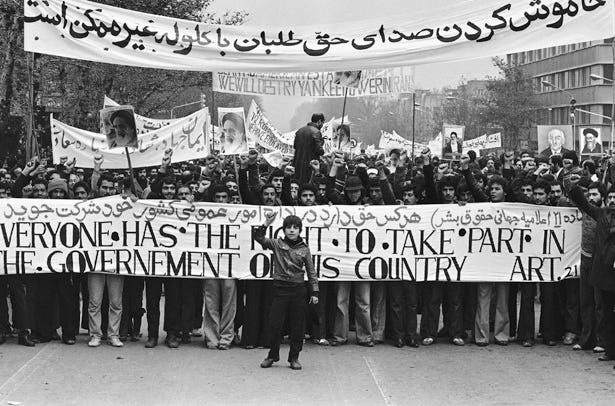
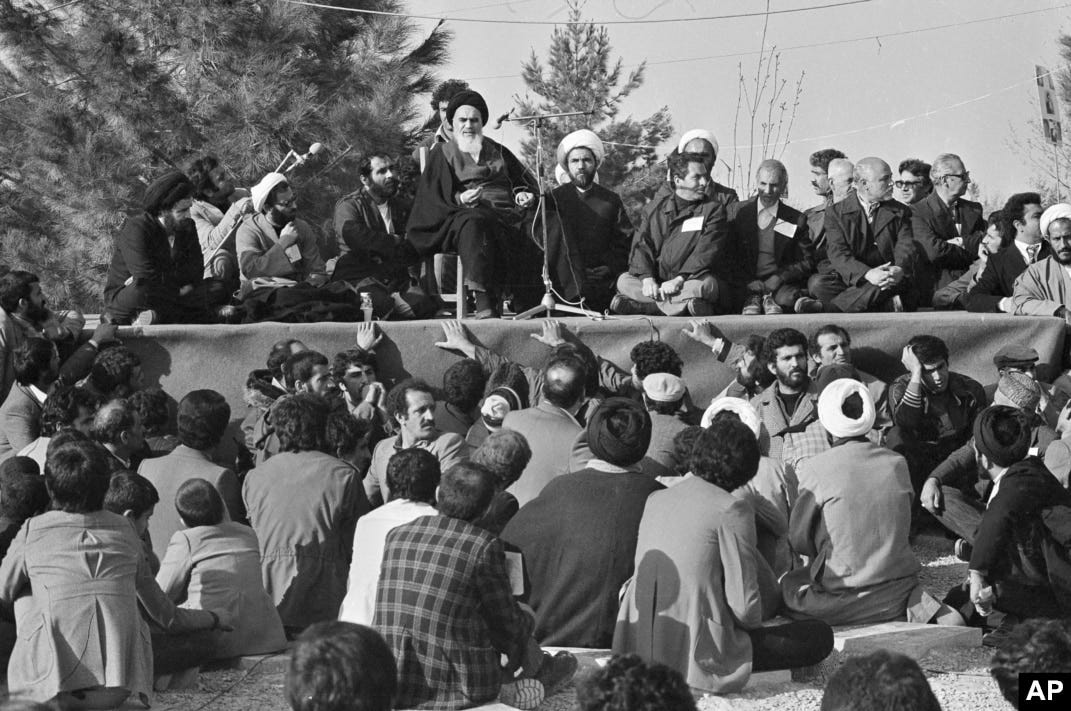
At the center of the storm, a frail, 76-year-old cleric in a black turban and gray robe sat in a modest house in the northern Tehran suburb of Davoodiyeh. Ayatollah Ruhollah Khomeini had returned from fifteen years of exile just ten days earlier, on February 1, to a crowd of several million that had paralyzed the city. Now, he was receiving a stream of military commanders, political leaders, and foreign journalists. One of them, an Italian reporter named Oriana Fallaci, asked him bluntly: “What kind of government will you have?”
“We have a right to hold a referendum. We have a right to decide our own destiny. We have a right to choose our own form of government.”
— Ayatollah Ruhollah Khomeini, in a speech at the Behesht-e Zahra cemetery, Tehran, February 1, 1979, hours after his return from exile.
Khomeini’s answer was serene and absolute. “A government of God,” he said. “A government where God is the ruler.”
That moment—the quiet, unyielding assertion in a room thick with cigarette smoke and revolutionary fervor—was the hinge. The popular uprising that had toppled a monarchy was about to be captured by a man who believed that sovereignty belonged not to the people, but to God. How that happened, and what it means for our understanding of revolution, is the story of 1979.
The Reconstruction
The Iranian Revolution is often called a “popular uprising,” but that label obscures more than it reveals. It was a multi-class, multi-ideological coalition that united against a common enemy—the Shah—but had no common vision for what came next. The tragedy of 1979 is that the coalition’s most disciplined, ruthless, and ideologically coherent faction won, and the others were crushed.
To understand how, we must first define the key terms and actors.
The Shah’s Regime: Mohammad Reza Pahlavi had ruled Iran since 1941, but his power was never absolute. In 1953, a CIA- and MI6-backed coup had toppled the democratically elected Prime Minister Mohammad Mossadegh, restoring the Shah to the throne. Thereafter, the Shah ruled through a brutal security apparatus—SAVAK, his secret police—and a program of top-down modernization known as the “White Revolution.” Land reform, women’s suffrage, and industrialization were imposed from above, but they uprooted traditional society, created a new urban proletariat, and alienated the bazaar merchants and clergy who had long been the backbone of Iranian civil society.
The Clergy: The Shi’a ulama (religious scholars) had historically held a position of moral authority in Iran, but they were not a monolith. The quietist tradition, exemplified by Ayatollah Mohammad Kazem Shariatmadari, held that clerics should guide society through counsel, not rule. The activist tradition, which Khomeini represented, argued that the clergy must directly govern in the absence of the Hidden Imam—the twelfth Shi’a imam who, according to doctrine, went into occultation in the 9th century and will return at the end of time. Khomeini’s innovation was velayat-e faqih (the Guardianship of the Jurist), a doctrine that vested supreme political authority in a single, qualified jurist. This was a radical break with Shi’a tradition.
The Left: The Marxist and Islamist-leftist groups—the Tudeh Party, the Fedayeen, and the Mojahedin-e Khalq (MEK)—had been the shock troops of the revolution. They organized the factory strikes, the street battles, and the armed resistance. They wanted a secular or Islamo-socialist republic. They were, in the end, the revolution’s gravediggers.
The Bazaar: The traditional merchant class had been the financial engine of the revolution, funding Khomeini’s network of mosques and pamphlets. They wanted an end to the Shah’s corruption and Westernization, but they were not necessarily theocrats.
The United States: The Carter administration, paralyzed by the hostage crisis that began in November 1979, had no coherent policy. It tried to salvage relations with the new regime, then broke them off. The U.S. had no leverage.
The central tension of the revolution was this: the people had risen for “freedom,” but the cleric who led them believed that freedom was submission to God’s law. Khomeini’s genius was to use the language of liberation to install a system of divine sovereignty.
The key documentary evidence for this argument is Khomeini’s own writings, particularly his 1970 book Islamic Government (or Velayat-e Faqih). In it, he argued that the monarchy was inherently un-Islamic, that the clergy must take direct political power, and that the jurist—the faqih—had the authority to overrule parliament. At the time, this was a fringe position. Most senior ayatollahs rejected it. But in the chaos of 1979, Khomeini was able to impose it.
The mechanism was the referendum of March 30-31, 1979. The question was simple: “Do you approve of an Islamic Republic?” The options were “yes” or “no.” There was no alternative. The result was a 98.2% “yes” vote. But what “Islamic Republic” meant was left deliberately vague. Khomeini had promised a “democratic Islamic Republic,” but within weeks, the word “democratic” was dropped. The constitution, drafted by a handpicked Assembly of Experts, created a system where the Supreme Leader (the faqih) had veto power over all legislation, control of the military and judiciary, and the authority to disqualify candidates for office.

The Layers
The Iranian Revolution was not just a political event; it was a seismic shift across every dimension of Iranian life.
Political Layer: The revolution created a new form of governance—the theocratic republic—that had no precedent in modern history. The Supreme Leader was not a king or a president; he was the representative of the Hidden Imam. This meant that
