


The accepted story is comfortable and, as far as it goes, true. The British monarchy survives because it has learned to bend. It gave up real political power gradually across the eighteenth and nineteenth centuries, absorbed the shocks of abdication in 1936 and divorce in 1992 and 1996, weathered Diana’s death and Andrew’s disgrace, and emerged each time as a slimmed-down, modernized, camera-ready institution that exists mostly to open hospitals and appear on stamps. Historians and royal correspondents alike tell this story as one of adaptation: the Crown trades substance for symbolism, and in exchange it survives. Charles III, in this telling, is simply the latest custodian of a brand — a king who talks about interfaith dialogue, invites imams and rabbis to his coronation, and speaks of defending “the space for faith itself” rather than any single church. It’s a generous and largely accurate account of an institution that has, genuinely, given up almost everything else.
The Question Nobody Asks
But if the monarchy has surrendered its armies, its veto, its land, and its private life to public scrutiny, why has it never surrendered the one thing written into its founding legal document — the requirement that the monarch be, by law, the Protestant head of a specific national church?
The Act of Settlement of 1701 is not folklore. It is a statute, still in force, that bars a Catholic — or anyone married to a Catholic before 2015’s minor amendment — from ever sitting on the throne, and requires the sovereign to be “in communion with the Church of England.” Every other disqualifying clause of that era — about foreign-born ministers, about needing Parliament’s consent to leave the realm — has been quietly repealed or left to rot. This one hasn’t. Why does a modern constitutional monarch, presiding over a country where under 40% identify as Christian and church attendance keeps falling, still legally require a religious test to wear the crown? The consensus narrative of “the adaptable monarchy” simply skips past this. It’s treated as ceremonial trivia, a costume detail for coronation day, rather than what it actually is: a live legal disqualification based on religion, sitting inside the constitution of a self-described pluralist democracy.
The Evidence
Start with the document itself. The Act of Settlement (1701) was passed by Parliament specifically to secure a Protestant succession after William III died without heirs, explicitly to prevent a return to Catholic monarchy following the trauma of James II’s deposition in 1688. Its language is blunt: anyone who “shall be reconciled to, or shall hold communion with, the See or Church of Rome” is permanently excluded from the throne, “as if such person or persons were naturally dead.” This is not metaphorical language — it equates conversion to Catholicism with legal death for succession purposes.
That clause survived the Perth Agreement of 2011, when the Commonwealth realms agreed to reforms — but those reforms only removed the ban on marrying a Catholic (via the Succession to the Crown Act 2013, effective 2015). The core requirement — that the monarch personally must be Anglican, and Head of the Church of England — was left entirely untouched. This was a deliberate choice by David Cameron’s government and the fifteen other Commonwealth realms, not an oversight; officials at the time explicitly stated the religious requirement on the monarch’s own faith would remain.
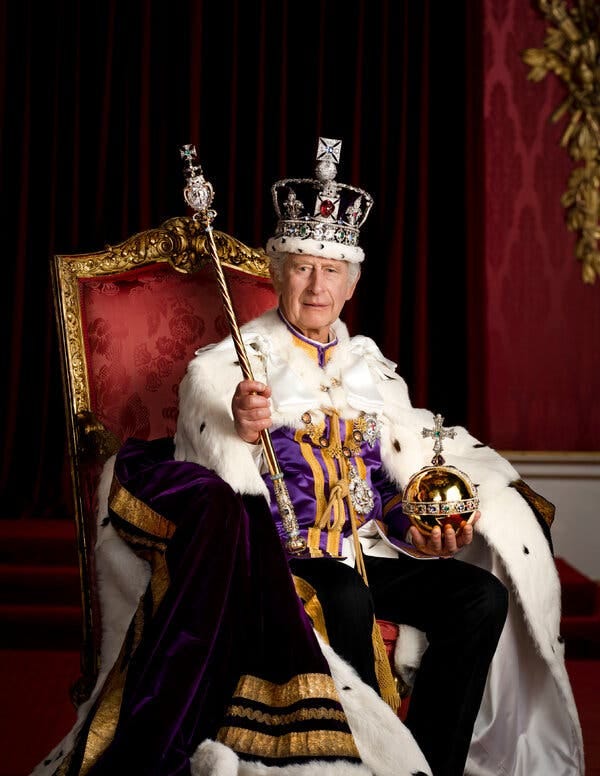
The coronation itself supplies the second piece of evidence. At Westminster Abbey on 6 May 2023, Charles III took the Coronation Oath, sworn since the Glorious Revolution, in which he promised to “maintain and preserve inviolably the settlement of the Church of England, and the doctrine, worship, discipline, and government thereof.” He then received the Anointing — performed behind a screen, out of camera view, using oil consecrated in Jerusalem, in a rite historians trace to the coronation of King Edgar in 973 CE. This is not incidental pageantry; it is the legal and sacramental mechanism by which the monarch becomes, formally, the Supreme Governor of the Church of England, a title dating to Henry VIII’s Act of Supremacy (1534) and Elizabeth I’s 1559 restoration of it.
Charles’s own conduct shows he felt the tension. Well before his accession, as Prince of Wales, he told the BBC in 1994 that he would rather be seen as “Defender of Faith” than “Defender of the Faith” — a phrase widely reported and much discussed by scholars of religion and monarchy such as Linda Woodhead. In his 2023 coronation, palace officials arranged for the Chief Rabbi, the Archbishop of Malankara, Hindu, Sikh, Muslim, and Buddhist leaders to participate in unprecedented ways, and Charles received blessings in multiple faith traditions after the Anglican rite concluded. He tried, visibly, to widen the tent while never once asking Parliament to remove the pole holding it up.

The Discomfort
None of this proves the monarchy is a fraud, or that Charles is insincere in his interfaith outreach — he has spoken about Islam and Judaism with more evident personal interest than most of his predecessors. What it does show is a structural mismatch that the “adaptable monarchy” narrative doesn’t want to look at directly: an institution that markets itself as evolving with the nation while retaining, unaltered, a legal religious test for its own head of state.
It’s worth being honest about what this doesn’t prove, too. It doesn’t prove disestablishment is coming, or that most British Catholics, Muslims, Hindus, or secular citizens are agitating over it — polling on the establishment of the Church of England consistently shows public apathy rather than outrage. It doesn’t prove the monarchy is uniquely hypocritical; almost every constitutional monarchy in Europe has some inherited entanglement with a national church it hasn’t fully resolved. And it doesn’t prove Charles personally wants to keep the religious test — his own words suggest ambivalence. What it does show is that the machinery of reform, when it comes to royal religion, moves only when forced (1701, 1688, 2013) and never moves on its own initiative toward removing a test that would, on paper, disqualify the majority of Charles’s own subjects from ever occupying the job he holds.
The Open Floor
I don’t think there’s a clean answer here, and I’d genuinely like to hear yours.
Is the Church of England’s establishment, and the monarch’s role as its Supreme Governor, a harmless historical relic — the constitutional equivalent of the Yeomen of the Guard’s Tudor uniforms — or is a religious test for head of state incompatible with a country that describes itself as pluralist and multi-faith?
Did Charles’s expanded, multi-faith coronation actually resolve the tension he identified in 1994, or did it just dress an unchanged legal structure in more inclusive clothing?
And if disestablishment were seriously proposed tomorrow, do you think it would come from the Church, from Parliament, from the Crown itself — or not at all?
Tell me where you land. I’ll be in the comments.