


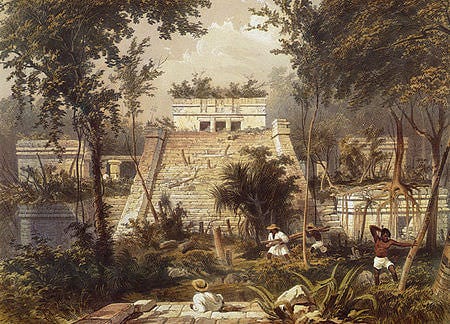
The Classic Maya collapse—roughly 750–950 AD—is one of history’s great cautionary tales. Over a few generations, the great city-states of the southern lowlands—Tikal, Palenque, Copán, Calakmul—emptied. Monument construction stopped. The hieroglyphic record fell silent. By 1000 AD, what had been one of the world’s most sophisticated civilizations was a ghost of itself, its cities swallowed by jungle.
For decades, the consensus has been clear: climate change did it. A series of severe, multi-decade droughts—confirmed by lake sediment cores from the Yucatán, cave speleothems, and isotopic analysis—coincides precisely with the collapse. The argument is elegant: the Maya had pushed their agricultural system to its limits, deforesting hillsides and draining wetlands to feed a population that may have reached 10–15 million. When the rains failed, the whole edifice buckled. Famine, war, and political disintegration followed.
This narrative is taught in textbooks, repeated in documentaries, and reinforced by every major paleoclimatology study since the 1990s. It is, in its broad strokes, almost certainly correct. The evidence for severe drought is overwhelming. The Maya did not vanish—millions of descendants live on—but their civilization’s political and cultural heartland collapsed, and drought appears to be the trigger.
The Question
But here is the question the consensus quietly avoids, the one that makes paleoclimatologists shift in their seats and archaeologists change the subject: If the Maya were so sophisticated—with 2,000 years of continuous observation of the skies, with calendars that tracked Venus and eclipses with precision, with a written record spanning centuries—did they see it coming?
We credit the Maya with astonishing astronomical knowledge. They calculated the solar year to within seconds. They predicted eclipses. They tracked the synodic period of Venus for centuries. Their Long Count calendar tracked time across millions of years. They understood cycles—agricultural, ritual, celestial—with a depth that still impresses modern astronomers.
And yet the consensus insists they were blindsided by a drought that lasted decades.
Is that plausible? Or have we imposed a modern assumption—that pre-modern people were passive victims of climate—on a civilization that spent centuries watching the skies?
The Evidence
Let us examine what the Maya actually knew about their climate—and what they might have seen coming.
First, the drought record. The evidence comes from multiple sources: Lake Chichancanab in the Yucatán, where oxygen isotope ratios in sediment cores show a dramatic drying between 750 and 950 AD, with the worst period around 800–900 AD. The Cariaco Basin off Venezuela shows reduced titanium concentrations, indicating weaker summer rains. Cave stalagmites from Belize and the Yucatán show the same pattern: a multi-century drying trend punctuated by severe multi-decade droughts.
The key finding: these were not sudden events. The drying was gradual, building over generations. The worst droughts lasted 20–30 years. The Maya had decades of warning—if they were watching.
Second, what the Maya watched. The Maya had been recording astronomical and meteorological phenomena for centuries. The Dresden Codex contains tables for predicting eclipses and tracking Venus. The Maya calendar was built on cycles—the 260-day tzolk’in, the 365-day haab’, the 52-year Calendar Round, the Long Count. They understood that celestial patterns repeated.
There is strong evidence they tracked rainfall cycles. The Maya word for “rain” (chaak) is also the name of their rain god. They built cenotes and chultuns (underground cisterns) to store water. They engineered reservoirs at Tikal that held millions of gallons. They knew how much rain fell, when it fell, and what happened when it didn’t.
Third, the uncomfortable correlation. The Maya recorded droughts in their inscriptions. At Copán, an inscription from 822 AD—the last dated monument—mentions “the burning of the sky” and “no rain for many years.” At Quiriguá, a stela from 810 AD describes a period of “great heat and drought.” The Maya were not silent about what was happening. They were documenting it.
Fourth, what they did with that knowledge. The evidence suggests the Maya responded to the growing crisis with intensification, not adaptation. They built more reservoirs, cleared more forest, expanded agricultural terraces. At Tikal, the reservoirs were expanded in the late 8th century. At Calakmul, the largest Maya city, the population peaked just before the collapse—and then collapsed.
But here is the crucial point: if the Maya could see the drought coming, why didn’t they do something different? Why didn’t they abandon cities earlier, or change their agricultural system, or migrate? The answer may be that they did see it coming—and their response made things worse.
The Discomfort
This is where the historical record becomes uncomfortable. The evidence suggests the Maya knew the drought was coming—and they responded by doubling down on the very system that was failing.
Consider: the Maya priesthood and elite were deeply invested in the calendar and its predictions. If the calendar told them that a long dry period was coming, what would they do? They would perform more rituals, build more temples, demand more tribute—all to appease the gods and restore the rains. The archaeological record shows exactly this: in the decades before the collapse, monument building increased at many sites. More stelae, more temples, more elaborate rituals.
The elite were not ignorant. They were trapped by their own worldview. The calendar that told them drought was coming also told them how to respond: through sacrifice, ritual, and intensification. To abandon that system would be to abandon their entire cosmology—and their own power.
The deeper discomfort is this: the Maya collapse may not be a story of ignorance, but of knowledge that couldn’t be acted upon. The Maya knew the skies. They knew the patterns. But their social and political system was built on the assumption that ritual could control nature. When the drought came, their knowledge told them what was happening—but their institutions could not accept the answer.
This does not prove that the Maya predicted the exact timing of the collapse. It does not prove that any individual Maya priest knew in 750 AD that the civilization would fall by 950 AD. But it raises the possibility that the Maya saw the drought coming, understood its severity, and were powerless to prevent the catastrophe because their own system prevented adaptation.
The implications are uncomfortable for us, too. We have better climate models, better data, better communication. We also have economic systems and political institutions that are deeply invested in the status quo. We know the droughts are coming—the megadrought in the American Southwest, the drying of the Amazon, the collapse of monsoon systems. And like the Maya, we are responding by building taller temples and demanding more tribute.

The Open Floor
The question is not just about the Maya. It is about us. Here is what I genuinely do not know, and I want to hear your thoughts:
1. If the Maya knew the drought was coming—and the evidence suggests they did—why did they stay? Was it inertia? Faith in ritual? A lack of alternatives? Or did some Maya leave, and we just don’t have the evidence?
2. How do we distinguish between a civilization that collapses because it didn’t see the crisis coming, and one that collapses because it saw it coming but couldn’t act? The historical record looks the same—abandoned cities, broken monuments, silence. But the moral and strategic lessons are completely different.
3. What would it mean if the Maya collapse was a case of knowing the future and still being unable to avoid it? Is there such a thing as a “trap of knowledge”—where understanding a problem actually prevents you from solving it because your entire worldview is built on that understanding?
I am genuinely uncertain about these questions. I suspect the answer is different for every Maya city—some were probably blindsided, others saw it coming but couldn’t change course, and a few may have adapted successfully only to be overwhelmed by refugees. The evidence is incomplete, and the honest answer is “we don’t know yet.”
But the question is worth asking. Because if the Maya saw the drought coming and still collapsed, then the lesson of their fall is not “climate change destroys civilizations.” It is something far more unsettling: knowledge is not enough. You also need the courage to act on it.
I look forward to your disagreement in the comments. What am I missing? What evidence contradicts this? What does the Maya case teach us—or fail to teach us—about our own future?